
Ch.20 - Electrochemistry
Brown - Chemistry: The Central Science 14th Edition
Brown14th EditionChemistry: The Central ScienceISBN: 9780134414232Non è quello che usi tu?Cambia libro di testo
Capitolo 20, Problema 28

Indicate whether each statement is true or false: (a) The anode is the electrode at which oxidation takes place. (b) A voltaic cell always has a positive emf.

Guida verificata passo dopo passo
1
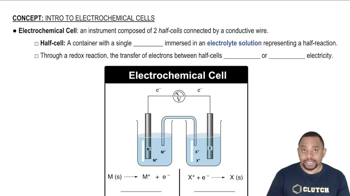
Step 1: Understand the concept of anode and cathode in electrochemical cells. The anode is the electrode where oxidation occurs, and the cathode is where reduction takes place. This is a fundamental principle in electrochemistry.
Step 2: Evaluate statement (a). Recall that oxidation involves the loss of electrons, and this process occurs at the anode. Therefore, statement (a) is true.
Step 3: Understand the concept of electromotive force (emf) in voltaic cells. A voltaic cell, also known as a galvanic cell, generates electrical energy from spontaneous chemical reactions. The emf is the potential difference between the two electrodes.
Step 4: Evaluate statement (b). In a voltaic cell, the chemical reaction is spontaneous, which means it has a positive emf. This is because the cell is designed to produce energy, not consume it.
Step 5: Conclude the evaluation by confirming that both statements are true based on the principles of electrochemistry and the nature of voltaic cells.

Concetti chiave

Ecco i concetti essenziali che devi comprendere per rispondere correttamente alla domanda.

Electrodes in Electrochemical Cells

In electrochemical cells, there are two electrodes: the anode and the cathode. The anode is where oxidation occurs, meaning it is the site where electrons are lost by a substance. Conversely, the cathode is where reduction takes place, involving the gain of electrons. Understanding the roles of these electrodes is crucial for analyzing electrochemical reactions.
Video consigliato:
Percorso guidato
02:46
Electrochemical Cells

Voltaic Cells and Electromotive Force (emf)

A voltaic cell, also known as a galvanic cell, generates electrical energy from spontaneous chemical reactions. The electromotive force (emf) of a voltaic cell is the maximum potential difference between its electrodes when no current is flowing. A positive emf indicates that the cell can perform work, making it essential to recognize that a functioning voltaic cell should always have a positive emf.
Video consigliato:
Percorso guidato
00:45
Electrolytic Cell Example

True/False Statements in Chemistry

In chemistry, evaluating statements as true or false often requires a clear understanding of fundamental principles. This involves applying knowledge of chemical reactions, cell components, and their functions. Accurately determining the truth of a statement hinges on recognizing established scientific facts and definitions, which is vital for effective problem-solving in chemistry.
Video consigliato:
Percorso guidato
01:29
Introduction to Organic Chemistry Example