

Ch.20 - Electrochemistry
Brown - Chemistry: The Central Science 14th Edition
Brown14th EditionChemistry: The Central ScienceISBN: 9780134414232Non è quello che usi tu?Cambia libro di testo
Capitolo 20, Problema 12b

Magnesium, the element, is produced commercially by electrolysis from a molten salt (the 'electrolyte') using a cell similar to the one shown here. (b) Chlorine gas is evolved as voltage is applied in the cell. Knowing this, identify the electrolyte.
Diagram of an electrolysis cell showing carbon and steel electrodes in an electrolyte, producing chlorine gas.

Guida verificata passo dopo passo
1
Identify the products of the electrolysis process. Here, chlorine gas (Cl2) is evolved at the anode (carbon electrode).
Determine the possible sources of chlorine gas. Chlorine gas is typically produced from chloride ions (Cl-).
Consider the common molten salts that contain chloride ions. Magnesium chloride (MgCl2) is a common electrolyte used in the production of magnesium.
Analyze the electrolysis reaction. At the anode, chloride ions (Cl-) are oxidized to chlorine gas (Cl2). At the cathode, magnesium ions (Mg2+) are reduced to magnesium metal (Mg).
Conclude that the electrolyte used in this electrolysis cell is likely magnesium chloride (MgCl2).

Risposta video verificata per un problema simile:

Questa soluzione video è stata consigliata dai nostri tutor come utile per risolvere questo problema.
Durata del video:
1m

Concetti chiave

Ecco i concetti essenziali che devi comprendere per rispondere correttamente alla domanda.

Electrolysis

Electrolysis is a chemical process that uses electrical energy to drive a non-spontaneous reaction. In this process, an electrolyte is decomposed into its constituent ions when an electric current is passed through it. The electrodes facilitate the movement of ions, leading to the production of substances such as gases or metals at the electrodes.
Video consigliato:
Percorso guidato
01:21
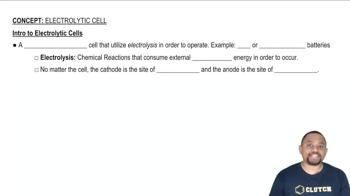
The Electrolytic Cell

Electrolyte

An electrolyte is a substance that, when dissolved in a solvent or melted, produces ions that can conduct electricity. In the context of electrolysis, the electrolyte allows the flow of electric current and is essential for the chemical reactions occurring at the electrodes. Common electrolytes include salts, acids, and bases, with molten salts often used in metal extraction processes.
Video consigliato:
Percorso guidato
02:50
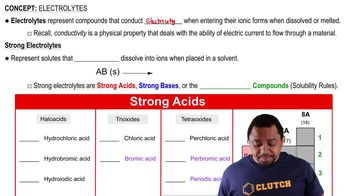
Electrolytes and Strong Acids

Chlorine Production

Chlorine gas (Cl2) is commonly produced during the electrolysis of sodium chloride (NaCl) solutions or molten NaCl. At the anode, chloride ions (Cl-) are oxidized to form chlorine gas, which is released as a byproduct. Understanding this reaction is crucial for identifying the electrolyte used in the electrolysis cell, as it indicates the presence of chloride ions in the electrolyte.
Video consigliato:
Percorso guidato
01:30
Production of Hydrogen Example