Ch.21 - Nuclear Chemistry
Brown - Chemistry: The Central Science 14th Edition
Brown14th EditionChemistry: The Central ScienceISBN: 9780134414232Non è quello che usi tu?Cambia libro di testo
Capitolo 21, Problema 52

Based on the following atomic mass values: 1H, 1.00782 amu; 2H, 2.01410 amu; 3H, 3.01605 amu; 3He, 3.01603 amu; 4He, 4.00260 amu—and the mass of the neutron given in the text, calculate the energy released per mole in each of the following nuclear reactions, all of which are possibilities for a controlled fusion process:
(a) 21H + 31H → 42He + 10n
(b) 21H + 21H → 32He + 10n
(c) 21H + 32He → 42He + 11H

Guida verificata passo dopo passo
1
Step 1: Identify the reactants and products in the nuclear reaction. In this case, the reactants are two 2H (deuterium) atoms and the products are one 3He (Helium-3) atom and one neutron (1n).
Step 2: Calculate the total mass of the reactants by adding the atomic masses of the two 2H atoms. Use the given atomic mass values.
Step 3: Calculate the total mass of the products by adding the atomic mass of the 3He atom and the mass of the neutron. Use the given atomic mass values.
Step 4: Calculate the mass difference between the reactants and the products by subtracting the total mass of the products from the total mass of the reactants. This mass difference is the mass that has been converted into energy during the nuclear reaction.
Step 5: Convert this mass difference into energy using Einstein's mass-energy equivalence principle, E=mc^2, where E is the energy, m is the mass, and c is the speed of light. Multiply the mass difference by c^2 to get the energy released per reaction. To get the energy released per mole of reactions, multiply this energy by Avogadro's number (6.022 x 10^23).

Risposta video verificata per un problema simile:

Questa soluzione video è stata consigliata dai nostri tutor come utile per risolvere questo problema.
Durata del video:
10m

Concetti chiave

Ecco i concetti essenziali che devi comprendere per rispondere correttamente alla domanda.

Nuclear Fusion

Nuclear fusion is the process where two light atomic nuclei combine to form a heavier nucleus, releasing energy in the process. This reaction occurs under extreme conditions of temperature and pressure, typically found in stars. The energy released is a result of the mass defect, where the mass of the resulting nucleus is less than the sum of the original masses, according to Einstein's equation E=mc².
Video consigliato:
Percorso guidato
02:06
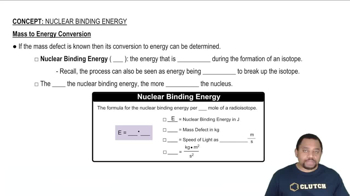
Nuclear Binding Energy

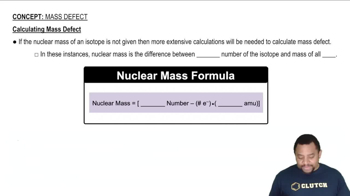
Mass Defect

The mass defect refers to the difference between the mass of an atomic nucleus and the sum of the masses of its individual protons and neutrons. This discrepancy arises because some mass is converted into energy during the formation of the nucleus. Understanding mass defect is crucial for calculating the energy released in nuclear reactions, as it directly relates to the binding energy of the nucleus.
Video consigliato:
Percorso guidato
00:55
Calculating Mass Defect

Energy Calculation in Nuclear Reactions

To calculate the energy released in nuclear reactions, one must first determine the mass defect by subtracting the total mass of the reactants from the total mass of the products. This mass defect is then converted into energy using Einstein's equation E=mc². The energy calculated is typically expressed in joules or kilojoules per mole, allowing for comparisons between different reactions and their feasibility for energy production.
Video consigliato:
Percorso guidato
02:06
Nuclear Binding Energy