Ch.21 - Nuclear Chemistry
Brown - Chemistry: The Central Science 14th Edition
Brown14th EditionChemistry: The Central ScienceISBN: 9780134414232Non è quello che usi tu?Cambia libro di testo
Capitolo 21, Problema 30d

Complete and balance the following nuclear equations by supplying the missing particle: (d) 5826Fe + 2 10n¡6027Co + ?

Guida verificata passo dopo passo
1
Identify the type of nuclear reaction. In this case, it appears to be a neutron capture reaction where a neutron is absorbed by a nucleus, resulting in a new element and possibly other particles.
Write down the given nuclear equation: \( ^{58}_{26}\text{Fe} + 2 \times ^{1}_{0}\text{n} \rightarrow ^{60}_{27}\text{Co} + ? \).
Apply the law of conservation of mass number and atomic number. The sum of mass numbers (top numbers) and atomic numbers (bottom numbers) on both sides of the equation must be equal.
Calculate the total mass number on the left side: \( 58 + 2 \times 1 = 60 \). The mass number on the right side is 60, so it is balanced.
Calculate the total atomic number on the left side: \( 26 + 2 \times 0 = 26 \). The atomic number on the right side is 27, so the missing particle must have an atomic number of \(-1\), which corresponds to a \( \beta^- \) particle (electron).

Risposta video verificata per un problema simile:

Questa soluzione video è stata consigliata dai nostri tutor come utile per risolvere questo problema.
Durata del video:
5m

Concetti chiave

Ecco i concetti essenziali che devi comprendere per rispondere correttamente alla domanda.

Nuclear Reactions

Nuclear reactions involve changes in an atom's nucleus and can result in the transformation of one element into another. They are characterized by the conservation of mass and charge, meaning that the total number of nucleons (protons and neutrons) and the total charge must remain constant before and after the reaction.
Video consigliato:
Percorso guidato
02:06
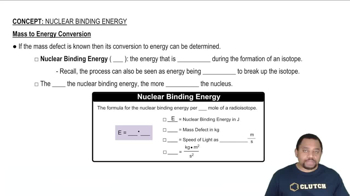
Nuclear Binding Energy

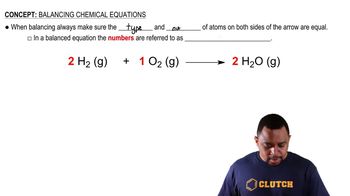
Balancing Nuclear Equations

Balancing nuclear equations requires ensuring that both the mass number (total number of protons and neutrons) and the atomic number (number of protons) are equal on both sides of the equation. This process often involves identifying missing particles, such as neutrons, protons, or alpha/beta particles, to achieve balance.
Video consigliato:
Percorso guidato
01:32
Balancing Chemical Equations

Types of Particles in Nuclear Reactions

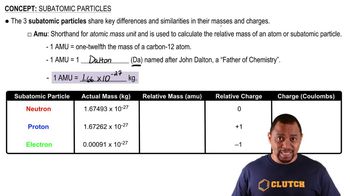
In nuclear reactions, various particles can be involved, including neutrons, protons, alpha particles (helium nuclei), and beta particles (electrons or positrons). Understanding the role of these particles is crucial for predicting the outcome of the reaction and for identifying what is missing in a given equation.
Video consigliato:
Percorso guidato
05:19
Subatomic Particles