Ch.21 - Nuclear Chemistry
Brown - Chemistry: The Central Science 14th Edition
Brown14th EditionChemistry: The Central ScienceISBN: 9780134414232Non è quello che usi tu?Cambia libro di testo
Capitolo 21, Problema 62

Complete and balance the nuclear equations for the following fission reactions:
(a) 23592U + 10n → 16062Sm + 7230Zn + _ 10n
(b) 23994Pu + 10n → 14458Ce + _ + 2 10n

Guida verificata passo dopo passo
1
Step 1: Identify the atomic and mass numbers on both sides of the equation. The atomic number (subscript) is the number of protons in an atom, and the mass number (superscript) is the sum of protons and neutrons. In the given equation, the atomic number on the left side is 92 (from Uranium) + 0 (from neutron) = 92. The mass number on the left side is 235 (from Uranium) + 1 (from neutron) = 236.
Step 2: The atomic number on the right side of the equation is currently 62 (from Samarium) + 30 (from Zinc) = 92. The mass number on the right side is currently 160 (from Samarium) + 72 (from Zinc) = 232.
Step 3: To balance the equation, the atomic and mass numbers on both sides of the equation must be equal. Currently, the atomic numbers are balanced (92 = 92), but the mass numbers are not (236 ≠ 232).
Step 4: To balance the mass numbers, we need to add the missing mass number to the right side of the equation. The difference between the mass numbers on the left and right side is 236 - 232 = 4. This means we need to add a particle with a mass number of 4 to the right side of the equation.
Step 5: The particle that fits this description is a neutron (10n), which has a mass number of 1 and an atomic number of 0. Since we need to add a mass number of 4, we need to add 4 neutrons to the right side of the equation. So, the balanced nuclear equation is: 23592U + 10n → 16062Sm + 7230Zn + 410n.

Risposta video verificata per un problema simile:

Questa soluzione video è stata consigliata dai nostri tutor come utile per risolvere questo problema.
Durata del video:
3m

Concetti chiave

Ecco i concetti essenziali che devi comprendere per rispondere correttamente alla domanda.

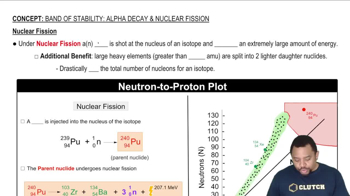
Nuclear Fission

Nuclear fission is a process in which a heavy nucleus splits into two or more lighter nuclei, along with the release of energy and neutrons. This reaction is typically initiated by the absorption of a neutron by the nucleus, leading to instability and subsequent division. Understanding fission is crucial for balancing nuclear equations, as it dictates the products formed and the energy released.
Video consigliato:
Percorso guidato
03:29
Band of Stability: Nuclear Fission

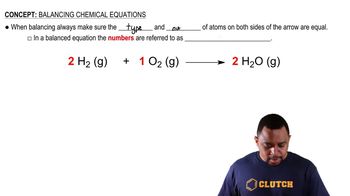
Balancing Nuclear Equations

Balancing nuclear equations involves ensuring that the total number of protons and neutrons is conserved on both sides of the equation. This means that the sum of atomic numbers (protons) and mass numbers (protons + neutrons) must be equal before and after the reaction. Mastery of this concept is essential for accurately completing and verifying nuclear reactions.
Video consigliato:
Percorso guidato
01:32
Balancing Chemical Equations

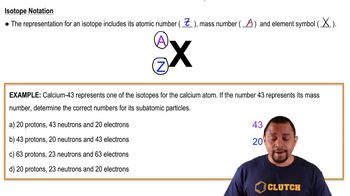
Isotopes and Atomic Notation

Isotopes are variants of a chemical element that have the same number of protons but different numbers of neutrons, resulting in different mass numbers. Atomic notation, which includes the element symbol, atomic number, and mass number, is used to represent isotopes in nuclear equations. Understanding isotopes is vital for identifying reactants and products in fission reactions, as well as for interpreting the changes in nuclear composition.
Video consigliato:
Percorso guidato
03:57
Isotope Notation Example