Ch.21 - Nuclear Chemistry
Brown - Chemistry: The Central Science 14th Edition
Brown14th EditionChemistry: The Central ScienceISBN: 9780134414232Non è quello che usi tu?Cambia libro di testo
Capitolo 21, Problema 12

What is the symbol for (a) a proton?

Guida verificata passo dopo passo
1
Understand that a proton is a subatomic particle found in the nucleus of an atom. It has a positive charge.
Recall that the symbol for a proton is derived from its elemental representation in chemistry.
Recognize that the proton is represented by the symbol for the hydrogen ion, as hydrogen is the simplest atom with one proton.
The symbol for a proton is often denoted as H^+, indicating a hydrogen ion with a positive charge.
Note that in nuclear chemistry, a proton can also be represented by the symbol p.

Concetti chiave

Ecco i concetti essenziali che devi comprendere per rispondere correttamente alla domanda.

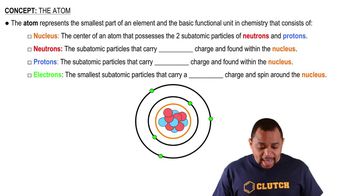
Atomic Structure

Atomic structure refers to the composition of an atom, which includes protons, neutrons, and electrons. Protons are positively charged particles found in the nucleus of an atom, and they play a crucial role in defining the atomic number and identity of an element.
Video consigliato:

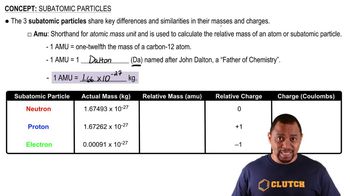
Subatomic Particles

Subatomic particles are the smaller constituents of an atom, primarily protons, neutrons, and electrons. Each of these particles has distinct properties; for instance, protons have a positive charge, neutrons are neutral, and electrons carry a negative charge, influencing the atom's overall charge and behavior.
Video consigliato:
Percorso guidato
05:19
Subatomic Particles

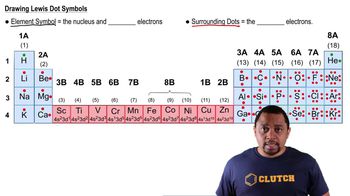
Chemical Symbols

Chemical symbols are one- or two-letter notations used to represent elements in the periodic table. The symbol for a proton is 'p' or 'p+', indicating its positive charge, and understanding these symbols is essential for communicating chemical information succinctly.
Video consigliato:
Percorso guidato
03:17
Lewis Dot Symbols