Ch.21 - Nuclear Chemistry
Brown - Chemistry: The Central Science 14th Edition
Brown14th EditionChemistry: The Central ScienceISBN: 9780134414232Non è quello che usi tu?Cambia libro di testo
Capitolo 21, Problema 9b

Indicate the number of protons and neutrons in the following nuclei: (b) 193Tl.

Guida verificata passo dopo passo
1
Identify the element from the given symbol: Tl is the symbol for thallium.
Determine the atomic number of thallium from the periodic table, which is 81. This number represents the number of protons in the nucleus.
The given isotope is 193Tl, where 193 is the mass number (A).
Calculate the number of neutrons using the formula: Neutrons = Mass number (A) - Atomic number (Z).
Substitute the known values into the formula: Neutrons = 193 - 81.

Risposta video verificata per un problema simile:

Questa soluzione video è stata consigliata dai nostri tutor come utile per risolvere questo problema.
Durata del video:
2m

Concetti chiave

Ecco i concetti essenziali che devi comprendere per rispondere correttamente alla domanda.

Atomic Number

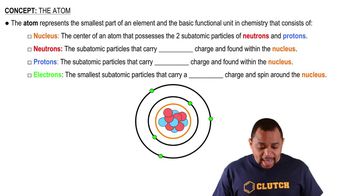
The atomic number of an element is the number of protons found in the nucleus of an atom. It uniquely identifies an element and determines its position on the periodic table. For example, thallium (Tl) has an atomic number of 81, meaning it has 81 protons.
Video consigliato:

Mass Number

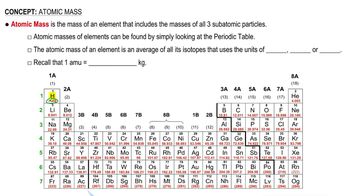
The mass number of an atom is the total number of protons and neutrons in its nucleus. It is represented as a whole number and is crucial for identifying isotopes of an element. In the case of 193Tl, the mass number is 193, indicating the combined total of protons and neutrons.
Video consigliato:

Neutrons

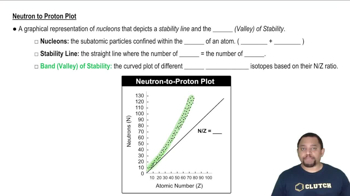
Neutrons are neutral subatomic particles found in the nucleus of an atom, alongside protons. The number of neutrons can be calculated by subtracting the atomic number from the mass number. For 193Tl, with 81 protons, the number of neutrons is 193 - 81 = 112.
Video consigliato:
Percorso guidato
01:38
Neutron-to-Proton Plot