
Ch.21 - Nuclear Chemistry
Brown - Chemistry: The Central Science 14th Edition
Brown14th EditionChemistry: The Central ScienceISBN: 9780134414232Non è quello che usi tu?Cambia libro di testo
Capitolo 21, Problema 43

Potassium-40 decays to argon-40 with a half-life of 1.27 * 109 yr. What is the age of a rock in which the mass ratio of 40Ar to 40K is 4.2?

Guida verificata passo dopo passo
1
Identify the decay process: Potassium-40 (\(^{40}\text{K}\)) decays to Argon-40 (\(^{40}\text{Ar}\)) through a radioactive decay process.
Use the given half-life of \(^{40}\text{K}\), which is 1.27 \(\times\) 10^9\) years, to determine the decay constant (\(\lambda\)) using the formula \(\lambda = \frac{\ln(2)}{\text{half-life}}\).
Apply the formula for radioactive decay: \(N_t = N_0 e^{-\lambda t}\), where \(N_t\) is the number of \(^{40}\text{K}\) atoms remaining, \(N_0\) is the initial number of \(^{40}\text{K}\) atoms, and \(t\) is the time elapsed.
Relate the mass ratio of \(^{40}\text{Ar}\) to \(^{40}\text{K}\) to the number of atoms: \(\frac{N_{\text{Ar}}}{N_{\text{K}}} = 4.2\), where \(N_{\text{Ar}}\) is the number of \(^{40}\text{Ar}\) atoms and \(N_{\text{K}}\) is the number of \(^{40}\text{K}\) atoms.
Solve for the age of the rock (\(t\)) using the relationship between \(N_{\text{Ar}}\), \(N_{\text{K}}\), and the decay constant \(\lambda\).

Risposta video verificata per un problema simile:

Questa soluzione video è stata consigliata dai nostri tutor come utile per risolvere questo problema.
Durata del video:
5m

Concetti chiave

Ecco i concetti essenziali che devi comprendere per rispondere correttamente alla domanda.

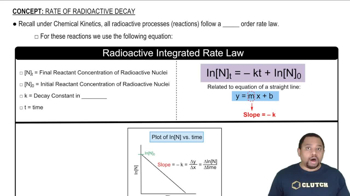
Radioactive Decay

Radioactive decay is the process by which an unstable atomic nucleus loses energy by emitting radiation. This decay occurs at a predictable rate characterized by the half-life, which is the time required for half of the radioactive substance to transform into a different element or isotope.
Video consigliato:
Percorso guidato
03:00
Rate of Radioactive Decay

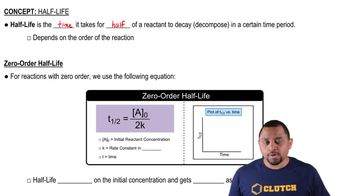
Half-Life

Half-life is a specific time period in which half of a given quantity of a radioactive isotope decays into its daughter product. For potassium-40, the half-life is 1.27 billion years, meaning that after this time, half of the original potassium-40 will have decayed into argon-40.
Video consigliato:
Percorso guidato
02:17
Zero-Order Half-life

Mass Ratio and Age Calculation

The mass ratio of daughter to parent isotopes can be used to determine the age of a rock through the equation derived from the decay law. By knowing the mass ratio of argon-40 to potassium-40 and the half-life, one can calculate the time elapsed since the rock formed, providing an estimate of its age.
Video consigliato:
Percorso guidato
02:14
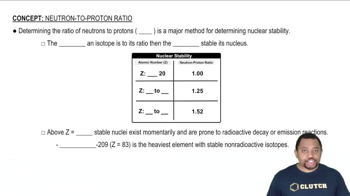
Neutron-Proton Ratio