
Ch.21 - Nuclear Chemistry
Brown - Chemistry: The Central Science 14th Edition
Brown14th EditionChemistry: The Central ScienceISBN: 9780134414232Non è quello che usi tu?Cambia libro di testo
Capitolo 21, Problema 82

The nuclear masses of 7Be, 9Be, and 10Be are 7.0147, 9.0100, and 10.0113 amu, respectively. Which of these nuclei has the largest binding energy per nucleon?

Guida verificata passo dopo passo
1
Step 1: The binding energy of a nucleus is the energy required to disassemble a nucleus into its constituent protons and neutrons. It is equivalent to the mass defect of the nucleus, which is the difference between the mass of the nucleus and the sum of the masses of its individual protons and neutrons.
Step 2: To find the binding energy, we first need to calculate the mass defect. The mass defect (Δm) can be calculated using the formula Δm = Zm_p + Nm_n - M, where Z is the number of protons, m_p is the mass of a proton, N is the number of neutrons, m_n is the mass of a neutron, and M is the mass of the nucleus.
Step 3: For each isotope of Beryllium (7Be, 9Be, and 10Be), calculate the mass defect using the given nuclear masses and the known masses of a proton (1.0073 amu) and a neutron (1.0087 amu).
Step 4: Convert the mass defect from atomic mass units (amu) to energy using Einstein's equation E=mc^2, where E is energy, m is mass, and c is the speed of light. Note that 1 amu is equivalent to 931.5 MeV/c^2.
Step 5: Finally, to find the binding energy per nucleon, divide the total binding energy by the number of nucleons (protons + neutrons) in the nucleus. The nucleus with the largest binding energy per nucleon is the most stable.

Risposta video verificata per un problema simile:

Questa soluzione video è stata consigliata dai nostri tutor come utile per risolvere questo problema.
Durata del video:
15m

Concetti chiave

Ecco i concetti essenziali che devi comprendere per rispondere correttamente alla domanda.

Binding Energy

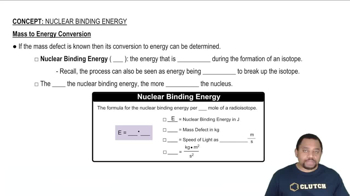
Binding energy is the energy required to disassemble a nucleus into its constituent protons and neutrons. It is a measure of the stability of a nucleus; the higher the binding energy, the more stable the nucleus. This energy arises from the strong nuclear force that holds the nucleons together, overcoming the repulsive electromagnetic force between protons.
Video consigliato:
Percorso guidato
02:06
Nuclear Binding Energy

Binding Energy per Nucleon

Binding energy per nucleon is calculated by dividing the total binding energy of a nucleus by the number of nucleons (protons and neutrons) it contains. This value provides a normalized measure of nuclear stability, allowing for comparison between different nuclei. A higher binding energy per nucleon indicates a more stable nucleus, which is crucial for understanding nuclear reactions and stability.
Video consigliato:
Percorso guidato
02:06
Nuclear Binding Energy

Mass Defect

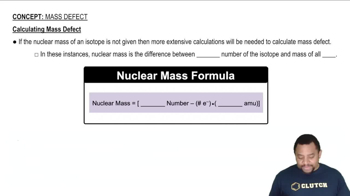
Mass defect refers to the difference between the mass of a nucleus and the sum of the individual masses of its constituent nucleons. This 'missing' mass is converted into binding energy according to Einstein's equation, E=mc². Understanding mass defect is essential for calculating the binding energy and, consequently, the binding energy per nucleon for different isotopes.
Video consigliato:
Percorso guidato
00:55
Calculating Mass Defect