
A 25.0-mL sample of 0.050 M barium nitrate solution was mixed with 25.0 mL of 0.050 M sodium sulfate solution labeled with radioactive sulfur-35. The activity of the initial sodium sulfate solution was 1.22 × 10⁶ Bq/mL. After the resultant precipitate was removed by filtration, the remaining filtrate was found to have an activity of 250 Bq/mL. (b) Calculate the Ksp for the precipitate under the conditions of the experiment.
Ch.21 - Nuclear Chemistry
Brown14th EditionChemistry: The Central ScienceISBN: 9780134414232Non è quello che usi tu?Cambia libro di testo
Capitolo 21, Problema 110
The two most common isotopes of uranium are 235U and 238U. (d) 238U undergoes radioactive decay to 234Th. How many protons, electrons, and neutrons are gained or lost by the 238U atom during this process?
Guida verificata passo dopo passo1
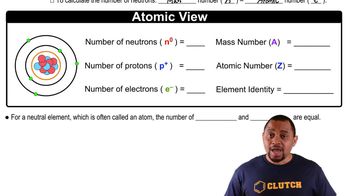
Identify the atomic number of uranium (U), which is 92. This means uranium has 92 protons and, in a neutral atom, 92 electrons.
Determine the number of neutrons in 238U by subtracting the atomic number from the mass number: 238 - 92 = 146 neutrons.
Understand that during the decay of 238U to 234Th, an alpha particle is emitted. An alpha particle consists of 2 protons and 2 neutrons.
Calculate the change in protons: 238U loses 2 protons, so the new element, thorium (Th), has 90 protons.
Calculate the change in neutrons: 238U loses 2 neutrons, so the new isotope, 234Th, has 144 neutrons. The number of electrons remains unchanged in this process.

Risposta video verificata per un problema simile:
Questa soluzione video è stata consigliata dai nostri tutor come utile per risolvere questo problema.
Durata del video:
4mConcetti chiave
Ecco i concetti essenziali che devi comprendere per rispondere correttamente alla domanda.
Isotopes
Isotopes are variants of a chemical element that have the same number of protons but different numbers of neutrons. For example, uranium-235 (235U) and uranium-238 (238U) are isotopes of uranium, with 235U having 143 neutrons and 238U having 146 neutrons. This difference in neutron count affects their stability and radioactive properties.
Video consigliato:
Percorso guidato
Isotopes
Radioactive Decay
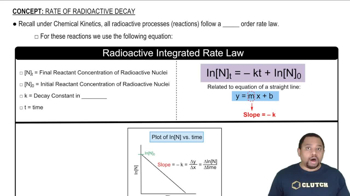
Radioactive decay is the process by which an unstable atomic nucleus loses energy by emitting radiation. This can result in the transformation of one element into another, as seen when 238U decays into 234Th. During this decay, particles such as alpha or beta particles may be emitted, leading to changes in the number of protons and neutrons in the nucleus.
Video consigliato:
Percorso guidato
Rate of Radioactive Decay
Nuclear Reactions and Particle Changes
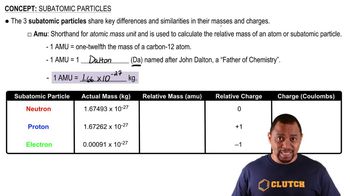
In nuclear reactions, the number of protons and neutrons in an atom can change, affecting its identity and charge. For instance, when 238U undergoes decay to form 234Th, it loses two protons and two neutrons, resulting in a new element. This change also affects the atom's overall charge, as the loss of protons alters the balance between protons and electrons.
Video consigliato:
Percorso guidato
Subatomic Particles
Pratica correlata
Domanda del libro di testo
1
views
Domanda del libro di testo
A 25.0-mL sample of 0.050 M barium nitrate solution was mixed with 25.0 mL of 0.050 M sodium sulfate solution labeled with radioactive sulfur-35. The activity of the initial sodium sulfate solution was 1.22⨉106 Bq/mL. After the resultant precipitate was removed by filtration, the remaining filtrate was found to have an activity of 250 Bq/mL. (a) Write a balanced chemical equation for the reaction that occurred.
533
views
