Ch.21 - Nuclear Chemistry
Brown - Chemistry: The Central Science 14th Edition
Brown14th EditionChemistry: The Central ScienceISBN: 9780134414232Non è quello che usi tu?Cambia libro di testo
Capitolo 21, Problema 14d

Write balanced nuclear equations for the following transformations: (d) gold-188 decays by positron emission.

Guida verificata passo dopo passo
1
Identify the initial isotope involved in the decay process. In this case, it is gold-188, which can be represented as Au188.
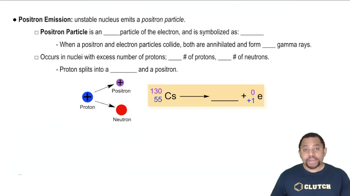
Understand the type of decay occurring. Positron emission involves the conversion of a proton into a neutron, releasing a positron (e0+1) and a neutrino.
Determine the new element formed after the decay. Since a proton is converted into a neutron, the atomic number decreases by 1. Gold (Au) has an atomic number of 79, so the new element will have an atomic number of 78, which is platinum (Pt).
Write the balanced nuclear equation. The mass number remains the same (188), but the atomic number changes from 79 to 78. The equation is: Au188 → Pt188 + e0+1.
Verify that the equation is balanced by checking that the sum of the atomic numbers and the sum of the mass numbers are equal on both sides of the equation.

Risposta video verificata per un problema simile:

Questa soluzione video è stata consigliata dai nostri tutor come utile per risolvere questo problema.
Durata del video:
3m

Concetti chiave

Ecco i concetti essenziali che devi comprendere per rispondere correttamente alla domanda.

Nuclear Decay

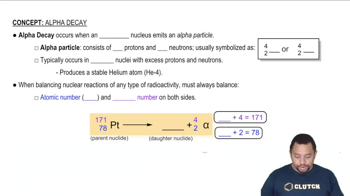
Nuclear decay is the process by which an unstable atomic nucleus loses energy by emitting radiation. This can occur in various forms, including alpha decay, beta decay, and positron emission. In positron emission, a proton in the nucleus is transformed into a neutron, releasing a positron and a neutrino, which alters the atomic number of the element.
Video consigliato:

Positron Emission

Positron emission is a type of beta decay where a proton is converted into a neutron, resulting in the emission of a positron (the antimatter counterpart of an electron) and a neutrino. This process decreases the atomic number of the element by one while keeping the mass number unchanged. It is commonly observed in isotopes that are proton-rich and unstable.
Video consigliato:
Percorso guidato
01:53
Positron Emission

Balanced Nuclear Equations

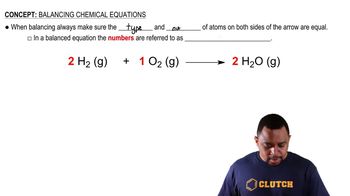
Balanced nuclear equations represent the transformation of one element into another during radioactive decay, ensuring that the total number of nucleons (protons and neutrons) and charge are conserved. In writing these equations, the initial and final isotopes, along with any emitted particles, must be accurately depicted to reflect the changes occurring in the nucleus during the decay process.
Video consigliato:
Percorso guidato
01:32
Balancing Chemical Equations