

Ch.22 - Chemistry of the Nonmetals
Brown - Chemistry: The Central Science 14th Edition
Brown14th EditionChemistry: The Central ScienceISBN: 9780134414232Non è quello che usi tu?Cambia libro di testo
Capitolo 22, Problema 6

Complete the exercises below. Account for the following observations: a. H₃PO₃ is a diprotic acid. b. Nitric acid is a strong acid, whereas phosphoric acid is weak. c. Phosphate rock is ineffective as a phosphate fertilizer. d. Phosphorus does not exist at room temperature as diatomic molecules, but nitrogen does. e. Solutions of Na₃PO₄ are quite basic.

Guida verificata passo dopo passo
1
Step 1: Understand the nature of H₃PO₃ as a diprotic acid. H₃PO₃, or phosphorous acid, can donate two protons (H⁺ ions) in solution. This is because one of the hydrogen atoms is directly bonded to phosphorus and does not ionize, while the other two are bonded to oxygen and can ionize.
Step 2: Compare the strength of nitric acid and phosphoric acid. Nitric acid (HNO₃) is a strong acid, meaning it completely dissociates in water, releasing all its protons. In contrast, phosphoric acid (H₃PO₄) is a weak acid, which only partially dissociates in solution, releasing fewer protons.
Step 3: Analyze why phosphate rock is ineffective as a phosphate fertilizer. Phosphate rock primarily contains insoluble calcium phosphate, which plants cannot readily absorb. For effective fertilization, phosphates need to be in a soluble form that plants can uptake.
Step 4: Explain why phosphorus does not exist as diatomic molecules at room temperature, but nitrogen does. Phosphorus typically forms P₄ tetrahedral molecules due to its larger atomic size and ability to form multiple bonds, whereas nitrogen forms N₂ diatomic molecules due to its ability to form a strong triple bond, which is stable at room temperature.
Step 5: Discuss why solutions of Na₃PO₄ are quite basic. Sodium phosphate (Na₃PO₄) dissociates in water to form Na⁺ ions and PO₄³⁻ ions. The phosphate ions can react with water to form hydroxide ions (OH⁻), increasing the pH and making the solution basic.

Concetti chiave

Ecco i concetti essenziali che devi comprendere per rispondere correttamente alla domanda.

Diprotic Acids

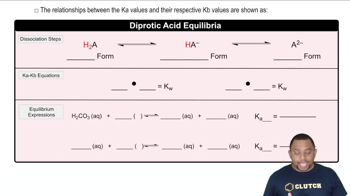
Diprotic acids are acids that can donate two protons (H⁺ ions) per molecule in an aqueous solution. An example is phosphorous acid (H₃PO₃), which can lose two protons in two steps, resulting in the formation of H₂PO₃⁻ and HPO₃²⁻ ions. Understanding the behavior of diprotic acids is essential for predicting their dissociation and the resulting pH of solutions.
Video consigliato:
Percorso guidato
04:40
3 forms of Diprotic Acids

Strong vs. Weak Acids

Strong acids, like nitric acid (HNO₃), completely dissociate in water, releasing all their protons, which results in a high concentration of H⁺ ions and a low pH. In contrast, weak acids, such as phosphoric acid (H₃PO₄), only partially dissociate, leading to a lower concentration of H⁺ ions and a higher pH. This distinction is crucial for understanding acid strength and its implications in chemical reactions.
Video consigliato:
Percorso guidato
02:19
Weak Acid-Strong Base Titration Curve

Basicity of Phosphate Compounds

Phosphate compounds, such as sodium phosphate (Na₃PO₄), can produce basic solutions when dissolved in water. This occurs because the phosphate ion (PO₄³⁻) can react with water to form hydroxide ions (OH⁻), increasing the pH of the solution. Recognizing the basic nature of phosphate solutions is important for applications in agriculture and environmental chemistry.
Video consigliato:
Percorso guidato
03:09
Rules for Writing Ionic Compounds