Complete the exercises below. Name the following compounds and assign oxidation states to the halogens in them: a. Fe(ClO₃)₃
Guida verificata passo dopo passo
1
Step 1: Identify the compound and its components. The compound given is Fe(ClO₃)₃, which consists of iron (Fe) and the chlorate ion (ClO₃⁻).
Step 2: Determine the oxidation state of iron (Fe). In this compound, iron is in the form of Fe³⁺ because it is combined with three chlorate ions, each carrying a -1 charge, balancing the overall charge to zero.
Step 3: Assign oxidation states to the elements in the chlorate ion (ClO₃⁻). Oxygen typically has an oxidation state of -2. Since there are three oxygen atoms, their total contribution is -6.
Step 4: Calculate the oxidation state of chlorine (Cl) in the chlorate ion. The sum of the oxidation states in the chlorate ion must equal the charge of the ion, which is -1. Let the oxidation state of Cl be x. Therefore, x + 3(-2) = -1.
Step 5: Solve for the oxidation state of chlorine (Cl). Rearrange the equation from Step 4 to find x, which represents the oxidation state of Cl in ClO₃⁻.
Concetti chiave
Ecco i concetti essenziali che devi comprendere per rispondere correttamente alla domanda.
Nomenclature of Ionic Compounds
Ionic compounds are named based on the cation and anion they contain. The cation is named first, followed by the anion, which often has a modified suffix. In the case of Fe(ClO₃)₃, iron (Fe) is the cation, and chlorate (ClO₃⁻) is the anion. The oxidation state of the metal is indicated by Roman numerals in the name, reflecting its charge in the compound.
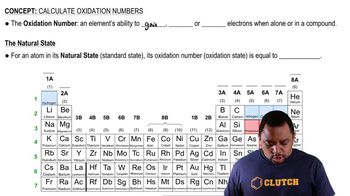
Oxidation states, or oxidation numbers, indicate the degree of oxidation of an atom in a compound. They help in understanding electron transfer during chemical reactions. In the compound Fe(ClO₃)₃, the oxidation state of chlorine in chlorate (ClO₃⁻) can be determined by knowing the overall charge of the ion and the typical oxidation states of oxygen, which is usually -2.
Polyatomic ions are ions composed of two or more atoms that are covalently bonded and carry a charge. Chlorate (ClO₃⁻) is an example of a polyatomic ion, consisting of one chlorine atom and three oxygen atoms. Understanding the structure and charge of polyatomic ions is essential for naming compounds and determining oxidation states in chemical formulas.


 Guida verificata passo dopo passo
 02:11
02:11