Ch.22 - Chemistry of the Nonmetals

Brown14th EditionChemistry: The Central ScienceISBN: 9780134414232
Non è quello che usi tu?Cambia libro di testoScegli un libro di testo diverso
TOC.tableOfContents
- Ch.1 - Introduction: Matter, Energy, and Measurement177
- Ch.2 - Atoms, Molecules, and Ions231
- Ch.3 - Chemical Reactions and Reaction Stoichiometry216
- Ch.4 - Reactions in Aqueous Solution189
- Ch.5 - Thermochemistry175
- Ch.6 - Electronic Structure of Atoms168
- Ch.7 - Periodic Properties of the Elements150
- Ch.8 - Basic Concepts of Chemical Bonding177
- Ch.9 - Molecular Geometry and Bonding Theories200
- Ch.10 - Gases179
- Ch.11 - Liquids and Intermolecular Forces113
- Ch.12 - Solids and Modern Materials154
- Ch.13 - Properties of Solutions157
- Ch.14 - Chemical Kinetics199
- Ch.15 - Chemical Equilibrium128
- Ch.16 - Acid-Base Equilibria164
- Ch.17 - Additional Aspects of Aqueous Equilibria163
- Ch.18 - Chemistry of the Environment105
- Ch.19 - Chemical Thermodynamics164
- Ch.20 - Electrochemistry171
- Ch.21 - Nuclear Chemistry122
- Ch.22 - Chemistry of the Nonmetals82
- Ch.23 - Transition Metals and Coordination Chemistry79
- Ch.24 - The Chemistry of Life: Organic and Biological Chemistry16
Brown14th EditionChemistry: The Central ScienceISBN: 9780134414232Non è quello che usi tu?Cambia libro di testo

Capitolo 22, Problema 62
Complete the exercises below. Write a balanced equation for each of the following reactions: a. hydrolysis of PCl₅ b. dehydration of phosphoric acid (also called orthophosphoric acid) to form pyrophosphoric acid.
 Guida verificata passo dopo passo
1
Identify the reactants and products for the hydrolysis of PCl₅. Hydrolysis involves the reaction of a compound with water. For PCl₅, the reaction with water will produce phosphoric acid (H₃PO₄) and hydrochloric acid (HCl).
Write the unbalanced chemical equation for the hydrolysis of PCl₅: \( \text{PCl}_5 + \text{H}_2\text{O} \rightarrow \text{H}_3\text{PO}_4 + \text{HCl} \).
Balance the chemical equation by ensuring the number of each type of atom is the same on both sides of the equation. Start by balancing the phosphorus atoms, then chlorine, hydrogen, and finally oxygen atoms.
For the dehydration of phosphoric acid, identify the reactants and products. Dehydration involves the removal of water. Orthophosphoric acid (H₃PO₄) will lose water to form pyrophosphoric acid (H₄P₂O₇).
Write the balanced chemical equation for the dehydration of phosphoric acid: \( 2\text{H}_3\text{PO}_4 \rightarrow \text{H}_4\text{P}_2\text{O}_7 + \text{H}_2\text{O} \).
Concetti chiave
Ecco i concetti essenziali che devi comprendere per rispondere correttamente alla domanda.
Balancing Chemical Equations
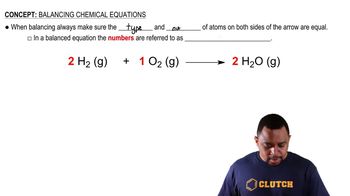
Balancing chemical equations involves ensuring that the number of atoms of each element is the same on both sides of the equation. This is based on the law of conservation of mass, which states that matter cannot be created or destroyed in a chemical reaction. To balance an equation, coefficients are adjusted in front of the chemical formulas to achieve equal atom counts.
Video consigliato:
Percorso guidato
 01:32
01:32
Balancing Chemical Equations
Hydrolysis Reactions
Hydrolysis reactions involve the reaction of a compound with water, leading to the breakdown of that compound. In the case of PCl₅, hydrolysis results in the formation of phosphoric acid and hydrochloric acid. Understanding the reactants and products of hydrolysis is crucial for writing the balanced equation accurately.
Video consigliato:
Percorso guidato
 01:30
01:30Alcohol Reactions: Dehydration Reactions
Dehydration Reactions
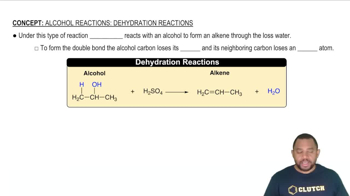
Dehydration reactions involve the removal of water from a compound, often resulting in the formation of a new compound. In the dehydration of phosphoric acid to form pyrophosphoric acid, a water molecule is eliminated. Recognizing the reactants and the nature of the reaction is essential for constructing the correct balanced equation.
Video consigliato:
Percorso guidato
01:30Alcohol Reactions: Dehydration Reactions
Pratica correlata