Ch.22 - Chemistry of the Nonmetals

Brown14th EditionChemistry: The Central ScienceISBN: 9780134414232
Non è quello che usi tu?Cambia libro di testoScegli un libro di testo diverso
TOC.tableOfContents
- Ch.1 - Introduction: Matter, Energy, and Measurement177
- Ch.2 - Atoms, Molecules, and Ions231
- Ch.3 - Chemical Reactions and Reaction Stoichiometry216
- Ch.4 - Reactions in Aqueous Solution189
- Ch.5 - Thermochemistry175
- Ch.6 - Electronic Structure of Atoms168
- Ch.7 - Periodic Properties of the Elements150
- Ch.8 - Basic Concepts of Chemical Bonding177
- Ch.9 - Molecular Geometry and Bonding Theories200
- Ch.10 - Gases179
- Ch.11 - Liquids and Intermolecular Forces113
- Ch.12 - Solids and Modern Materials154
- Ch.13 - Properties of Solutions157
- Ch.14 - Chemical Kinetics199
- Ch.15 - Chemical Equilibrium128
- Ch.16 - Acid-Base Equilibria164
- Ch.17 - Additional Aspects of Aqueous Equilibria163
- Ch.18 - Chemistry of the Environment105
- Ch.19 - Chemical Thermodynamics164
- Ch.20 - Electrochemistry171
- Ch.21 - Nuclear Chemistry122
- Ch.22 - Chemistry of the Nonmetals82
- Ch.23 - Transition Metals and Coordination Chemistry79
- Ch.24 - The Chemistry of Life: Organic and Biological Chemistry16
Brown14th EditionChemistry: The Central ScienceISBN: 9780134414232Non è quello che usi tu?Cambia libro di testo

Capitolo 22, Problema 22
What does hydrogen have in common with the halogens? Explain.
 Guida verificata passo dopo passo
1
Step 1: Understand the periodic table placement of hydrogen and the halogens. Hydrogen is located in Group 1, while the halogens are in Group 17.
Step 2: Recognize that both hydrogen and the halogens have one electron less than a full outer shell. Hydrogen has one electron, needing one more to complete its shell, similar to halogens which have seven valence electrons and need one more to complete their octet.
Step 3: Note the chemical reactivity similarity. Both hydrogen and halogens tend to form bonds by gaining or sharing one electron to achieve a stable electron configuration.
Step 4: Consider the types of compounds they form. Hydrogen can form compounds like hydrogen halides (e.g., HCl, HF) with halogens, where it shares its electron to form a covalent bond.
Step 5: Reflect on the non-metallic nature of both. Hydrogen, like the halogens, is a non-metal and shares similar properties such as forming diatomic molecules (H2, Cl2, etc.) in their elemental state.
Concetti chiave
Ecco i concetti essenziali che devi comprendere per rispondere correttamente alla domanda.
Group Properties in the Periodic Table
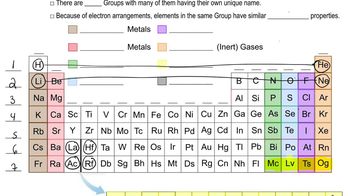
Elements in the periodic table are organized into groups based on similar chemical properties. Hydrogen, while not a halogen, shares some characteristics with the halogens (Group 17) due to its electron configuration. Both groups can form diatomic molecules and exhibit similar reactivity patterns, particularly in forming acids with nonmetals.
Video consigliato:
Percorso guidato
 05:33
05:33
Periodic Table: Group Names
Electron Configuration
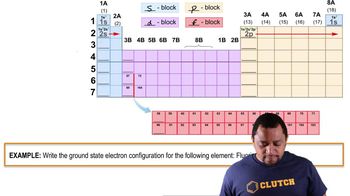
The electron configuration of an element describes the distribution of electrons in its atomic orbitals. Hydrogen has one electron in its outer shell, similar to halogens, which have seven valence electrons. This similarity allows hydrogen to participate in similar chemical reactions, such as forming bonds with other elements to achieve a stable electron configuration.
Video consigliato:
Percorso guidato
 01:33
01:33Electron Configuration Example
Acid-Base Chemistry
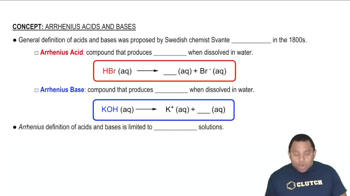
Hydrogen and halogens are involved in acid-base reactions, where hydrogen can act as a proton donor (acid) and halogens can form acids when combined with hydrogen. For example, hydrogen chloride (HCl) is a strong acid formed from hydrogen and chlorine. This relationship highlights the reactivity of hydrogen in forming compounds that exhibit acidic properties, akin to the behavior of halogens.
Video consigliato:
Percorso guidato
 02:00
02:00Arrhenius Acids and Bases
Pratica correlata