Ch.23 - Transition Metals and Coordination Chemistry

Brown14th EditionChemistry: The Central ScienceISBN: 9780134414232
Non è quello che usi tu?Cambia libro di testoScegli un libro di testo diverso
TOC.tableOfContents
- Ch.1 - Introduction: Matter, Energy, and Measurement177
- Ch.2 - Atoms, Molecules, and Ions231
- Ch.3 - Chemical Reactions and Reaction Stoichiometry216
- Ch.4 - Reactions in Aqueous Solution189
- Ch.5 - Thermochemistry175
- Ch.6 - Electronic Structure of Atoms168
- Ch.7 - Periodic Properties of the Elements150
- Ch.8 - Basic Concepts of Chemical Bonding177
- Ch.9 - Molecular Geometry and Bonding Theories200
- Ch.10 - Gases179
- Ch.11 - Liquids and Intermolecular Forces113
- Ch.12 - Solids and Modern Materials154
- Ch.13 - Properties of Solutions157
- Ch.14 - Chemical Kinetics199
- Ch.15 - Chemical Equilibrium128
- Ch.16 - Acid-Base Equilibria164
- Ch.17 - Additional Aspects of Aqueous Equilibria163
- Ch.18 - Chemistry of the Environment105
- Ch.19 - Chemical Thermodynamics164
- Ch.20 - Electrochemistry171
- Ch.21 - Nuclear Chemistry122
- Ch.22 - Chemistry of the Nonmetals82
- Ch.23 - Transition Metals and Coordination Chemistry79
- Ch.24 - The Chemistry of Life: Organic and Biological Chemistry16
Brown14th EditionChemistry: The Central ScienceISBN: 9780134414232Non è quello che usi tu?Cambia libro di testo
Tutti i libri di testo Brown 14th EditionCh.23 - Transition Metals and Coordination ChemistryProblema 46
Brown 14th EditionCh.23 - Transition Metals and Coordination ChemistryProblema 46Capitolo 23, Problema 46
Complete the exercises below. Determine if each of the following metal complexes is chiral and therefore has an optical isomer: c. octahedral cis-[V(en)₂ClBr].
 Guida verificata passo dopo passo
1
Identify the geometry of the complex: The complex is octahedral, which means it has six ligands arranged around the central metal ion in an octahedral shape.
Examine the ligands: The complex contains two ethylenediamine (en) ligands, one chloride (Cl) ligand, and one bromide (Br) ligand.
Determine the arrangement of ligands: In a cis configuration, the two identical ligands (in this case, the two en ligands) are adjacent to each other.
Check for chirality: A complex is chiral if it cannot be superimposed on its mirror image. In octahedral complexes, chirality often arises when there are bidentate ligands like en that create an asymmetrical arrangement.
Conclude about optical isomerism: If the complex is chiral, it will have non-superimposable mirror images, known as optical isomers.
Concetti chiave
Ecco i concetti essenziali che devi comprendere per rispondere correttamente alla domanda.
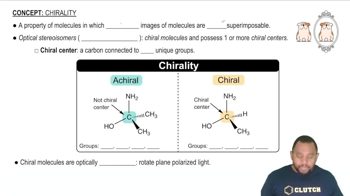
Chirality
Chirality refers to the geometric property of a molecule that makes it non-superimposable on its mirror image, much like left and right hands. A chiral molecule typically has an asymmetric carbon atom, but in coordination complexes, chirality can arise from the arrangement of ligands around a central metal atom. Understanding chirality is essential for determining whether a complex can exist in two optical isomers.
Video consigliato:
Percorso guidato
 02:37
02:37
Chirality
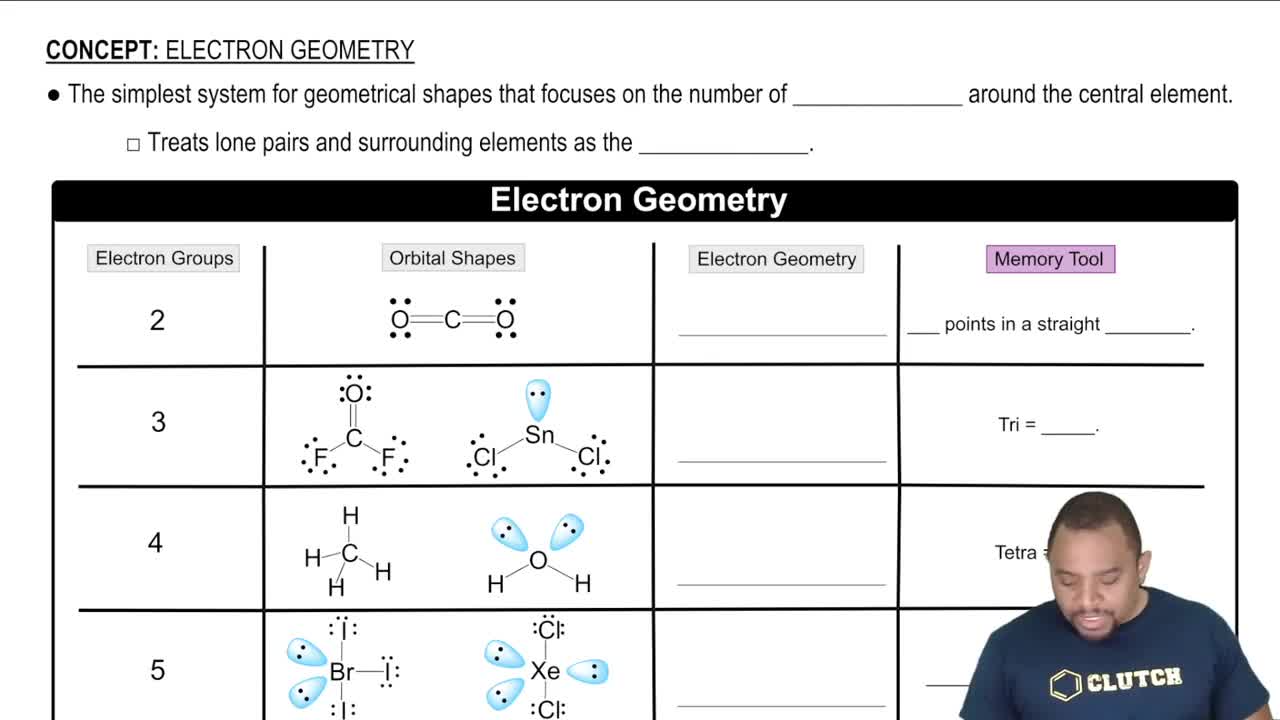
Octahedral Geometry
Octahedral geometry is a common arrangement in coordination chemistry where a central metal atom is surrounded by six ligands at the corners of an octahedron. The spatial arrangement of these ligands can lead to different isomeric forms, including cis and trans configurations. In the case of the complex cis-[V(en)₂ClBr], the specific arrangement of the ligands is crucial for assessing its chirality.
Video consigliato:
Percorso guidato
 04:44
04:44Electron Geometry
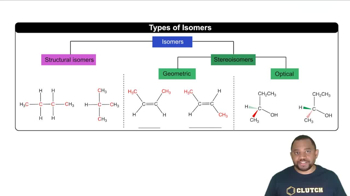
Optical Isomers
Optical isomers, or enantiomers, are pairs of chiral molecules that are mirror images of each other and cannot be superimposed. These isomers exhibit different optical activities, meaning they rotate plane-polarized light in opposite directions. The presence of optical isomers in a metal complex indicates chirality, which is determined by the arrangement of ligands and the overall symmetry of the complex.
Video consigliato:
Percorso guidato
 03:05
03:05Types of Isomers
Pratica correlata