Ch.23 - Transition Metals and Coordination Chemistry

Brown14th EditionChemistry: The Central ScienceISBN: 9780134414232
Non è quello che usi tu?Cambia libro di testoScegli un libro di testo diverso
TOC.tableOfContents
- Ch.1 - Introduction: Matter, Energy, and Measurement177
- Ch.2 - Atoms, Molecules, and Ions231
- Ch.3 - Chemical Reactions and Reaction Stoichiometry216
- Ch.4 - Reactions in Aqueous Solution189
- Ch.5 - Thermochemistry175
- Ch.6 - Electronic Structure of Atoms168
- Ch.7 - Periodic Properties of the Elements150
- Ch.8 - Basic Concepts of Chemical Bonding177
- Ch.9 - Molecular Geometry and Bonding Theories200
- Ch.10 - Gases179
- Ch.11 - Liquids and Intermolecular Forces113
- Ch.12 - Solids and Modern Materials154
- Ch.13 - Properties of Solutions157
- Ch.14 - Chemical Kinetics199
- Ch.15 - Chemical Equilibrium128
- Ch.16 - Acid-Base Equilibria164
- Ch.17 - Additional Aspects of Aqueous Equilibria163
- Ch.18 - Chemistry of the Environment105
- Ch.19 - Chemical Thermodynamics164
- Ch.20 - Electrochemistry171
- Ch.21 - Nuclear Chemistry122
- Ch.22 - Chemistry of the Nonmetals82
- Ch.23 - Transition Metals and Coordination Chemistry79
- Ch.24 - The Chemistry of Life: Organic and Biological Chemistry16
Brown14th EditionChemistry: The Central ScienceISBN: 9780134414232Non è quello che usi tu?Cambia libro di testo
Tutti i libri di testo Brown 14th EditionCh.23 - Transition Metals and Coordination ChemistryProblema 37
Brown 14th EditionCh.23 - Transition Metals and Coordination ChemistryProblema 37Capitolo 23, Problema 37
Complete the exercises below. Write the names of the following compounds, using the standard nomenclature rules for coordination complexes: d. [Pt(H₂O)₄(C₂O₄)]Br₂
 Guida verificata passo dopo passo
1
Identify the central metal atom in the coordination complex, which is platinum (Pt) in this case.
Determine the oxidation state of the central metal. The complex is neutral overall, and the charge of the oxalate ligand (C₂O₄) is -2. Since there are two bromide ions (Br⁻) outside the coordination sphere, the oxidation state of Pt can be calculated.
List the ligands in alphabetical order. Here, the ligands are water (H₂O) and oxalate (C₂O₄). Water is a neutral ligand, and oxalate is a bidentate ligand with a -2 charge.
Name the ligands: 'aqua' for water and 'oxalato' for oxalate. Since there are four water molecules, use the prefix 'tetra' for 'tetra-aqua'.
Combine the names: Start with the ligands in alphabetical order followed by the metal with its oxidation state in Roman numerals. The name of the complex is 'tetra-aqua-oxalato-platinum(II) bromide'.
Concetti chiave
Ecco i concetti essenziali che devi comprendere per rispondere correttamente alla domanda.
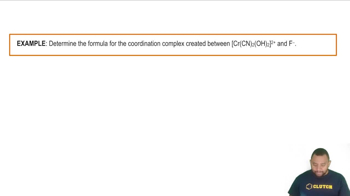
Coordination Complexes
Coordination complexes consist of a central metal atom or ion bonded to surrounding molecules or ions, known as ligands. The arrangement and type of ligands influence the properties and reactivity of the complex. Understanding the structure of coordination complexes is essential for naming them correctly.
Video consigliato:
Percorso guidato
 00:43
00:43
Coordination Complexes Example
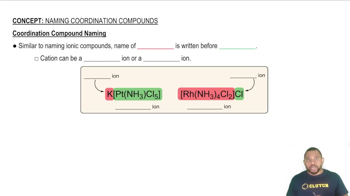
Nomenclature of Coordination Compounds
The nomenclature of coordination compounds follows specific rules established by the International Union of Pure and Applied Chemistry (IUPAC). This includes naming the ligands first, followed by the metal, and indicating the oxidation state of the metal in Roman numerals. The overall charge of the complex also affects the naming of the counterions.
Video consigliato:
Percorso guidato
 01:32
01:32Coordination Compound Naming
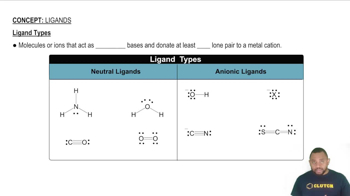
Ligands and Their Types
Ligands are ions or molecules that donate electron pairs to the central metal atom in a coordination complex. They can be classified as monodentate (binding through one atom), bidentate (binding through two atoms), or polydentate (binding through multiple atoms). The nature and number of ligands play a crucial role in determining the stability and geometry of the complex.
Video consigliato:
Percorso guidato
 02:38
02:38Ligand Types
Pratica correlata