Ch.23 - Transition Metals and Coordination Chemistry
Brown - Chemistry: The Central Science 14th Edition
Brown14th EditionChemistry: The Central ScienceISBN: 9780134414232Non è quello che usi tu?Cambia libro di testo
Capitolo 23, Problema 71a

Sketch the structure of the complex in each of the following compounds and give the full compound name:
a. cis-[Co(NH3)4(H2O)2] (NO3)2

Guida verificata passo dopo passo
1
Identify the central metal atom in the complex. In this case, it is cobalt (Co).
Determine the coordination number of the metal, which is the number of atoms directly bonded to the metal. Here, cobalt is bonded to 4 ammonia (NH3) molecules and 2 water (H2O) molecules, making the coordination number 6.
Recognize the geometry of the complex based on the coordination number. A coordination number of 6 typically leads to an octahedral geometry.
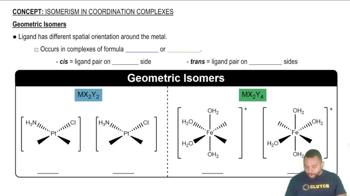
Arrange the ligands around the cobalt in a cis configuration. In an octahedral complex, cis means that the two similar ligands (in this case, the two water molecules) are adjacent to each other.
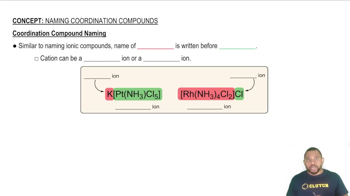
Name the compound using the rules for naming coordination complexes. Start with the names of the ligands in alphabetical order, followed by the metal with its oxidation state in Roman numerals, and finally the counter ions. For this complex, the name would be cis-tetraamminediaquacobalt(III) nitrate.

Risposta video verificata per un problema simile:

Questa soluzione video è stata consigliata dai nostri tutor come utile per risolvere questo problema.
Durata del video:
10m

Concetti chiave

Ecco i concetti essenziali che devi comprendere per rispondere correttamente alla domanda.

Coordination Compounds

Coordination compounds consist of a central metal atom or ion bonded to surrounding molecules or ions known as ligands. The arrangement and type of ligands influence the properties and geometry of the complex. Understanding the nature of these interactions is crucial for sketching the structure of coordination complexes.
Video consigliato:
Percorso guidato
01:32
Coordination Compound Naming

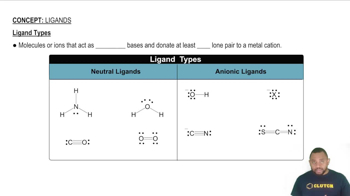
Ligands and Their Types

Ligands are ions or molecules that donate electron pairs to the central metal atom in a coordination complex. They can be classified as monodentate (binding through one atom) or polydentate (binding through multiple atoms). In the given compound, ammonia (NH3) acts as a monodentate ligand, while water (H2O) also serves as a ligand, affecting the overall structure and stability of the complex.
Video consigliato:

Geometric Isomerism

Geometric isomerism occurs in coordination compounds when ligands can be arranged differently around the central metal atom, leading to distinct spatial configurations. In the case of the compound provided, the 'cis' designation indicates that the ligands are adjacent to each other, which is important for accurately sketching the structure and understanding its chemical behavior.
Video consigliato:
Percorso guidato
02:02
Geometric Isomers