Ch.24 - The Chemistry of Life: Organic and Biological Chemistry
Brown - Chemistry: The Central Science 14th Edition
Brown14th EditionChemistry: The Central ScienceISBN: 9780134414232Non è quello che usi tu?Cambia libro di testo
Capitolo 24, Problema 51b

Write a balanced chemical equation using condensed structural formulas for the saponification (base hydrolysis) of
b. phenyl acetate.

Guida verificata passo dopo passo
1
Identify the structure of phenyl acetate, which is an ester formed from acetic acid and phenol. The condensed structural formula for phenyl acetate is C6H5OCOCH3.
Recognize that saponification involves the reaction of an ester with a strong base (commonly NaOH) to form an alcohol and a carboxylate salt.
Write the chemical formula for the base, NaOH, which will be used to hydrolyze the ester.
Set up the reaction: phenyl acetate (C6H5OCOCH3) reacts with NaOH. The ester bond in phenyl acetate will be broken, forming phenol (C6H5OH) and sodium acetate (CH3COONa).
Balance the chemical equation to ensure the number of atoms for each element is the same on both sides of the equation. The balanced equation should reflect a 1:1 molar ratio between phenyl acetate and NaOH.

Risposta video verificata per un problema simile:

Questa soluzione video è stata consigliata dai nostri tutor come utile per risolvere questo problema.
Durata del video:
4m

Concetti chiave

Ecco i concetti essenziali che devi comprendere per rispondere correttamente alla domanda.

Saponification

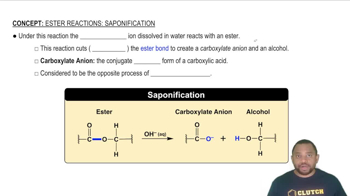
Saponification is a chemical reaction that involves the hydrolysis of an ester in the presence of a base, typically sodium hydroxide (NaOH) or potassium hydroxide (KOH). This process produces an alcohol and a carboxylate salt, which is commonly known as soap. In the context of phenyl acetate, saponification results in the formation of phenol and sodium acetate.
Video consigliato:
Percorso guidato
01:25
Ester Reactions: Saponification

Condensed Structural Formulas

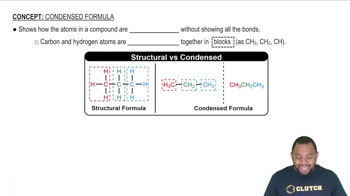
Condensed structural formulas provide a simplified representation of a molecule's structure, showing the arrangement of atoms and the connectivity between them without depicting all the bonds explicitly. This notation is useful for illustrating the reactants and products in a chemical reaction, allowing chemists to quickly understand the molecular composition and relationships in the reaction.
Video consigliato:
Percorso guidato
01:53
Condensed Formula

Balancing Chemical Equations

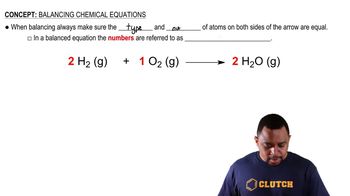
Balancing chemical equations is the process of ensuring that the number of atoms for each element is the same on both the reactant and product sides of the equation. This is based on the law of conservation of mass, which states that matter cannot be created or destroyed in a chemical reaction. A balanced equation accurately reflects the stoichiometry of the reaction, allowing for the correct prediction of product yields and reactant consumption.
Video consigliato:
Percorso guidato
01:32
Balancing Chemical Equations