Ch.3 - Chemical Reactions and Reaction Stoichiometry
Brown - Chemistry: The Central Science 14th Edition
Brown14th EditionChemistry: The Central ScienceISBN: 9780134414232Non è quello che usi tu?Cambia libro di testo
Capitolo 3, Problema 90a

(a) Ibuprofen is a common over-the-counter analgesic with the formula C13H18O2. How many moles of C13H18O2 are in a 500-mg tablet of ibuprofen? Assume the tablet is composed entirely of ibuprofen.

Guida verificata passo dopo passo
1
First, determine the molar mass of ibuprofen (C13H18O2) by adding the atomic masses of all the atoms in the formula. Use the periodic table to find the atomic masses: Carbon (C) is approximately 12.01 g/mol, Hydrogen (H) is approximately 1.01 g/mol, and Oxygen (O) is approximately 16.00 g/mol.
Calculate the molar mass of ibuprofen by multiplying the number of each type of atom by its atomic mass and then summing these values: (13 * 12.01 g/mol) + (18 * 1.01 g/mol) + (2 * 16.00 g/mol).
Convert the mass of the ibuprofen tablet from milligrams to grams, since molar mass is in grams per mole. Remember that 1 gram = 1000 milligrams, so divide 500 mg by 1000 to convert to grams.
Use the formula for moles, which is: moles = mass (in grams) / molar mass (in g/mol). Substitute the mass of the ibuprofen tablet in grams and the molar mass of ibuprofen into this formula.
Perform the division to find the number of moles of ibuprofen in the 500-mg tablet. This will give you the final answer in moles.

Risposta video verificata per un problema simile:

Questa soluzione video è stata consigliata dai nostri tutor come utile per risolvere questo problema.
Durata del video:
1m

Concetti chiave

Ecco i concetti essenziali che devi comprendere per rispondere correttamente alla domanda.

Molar Mass

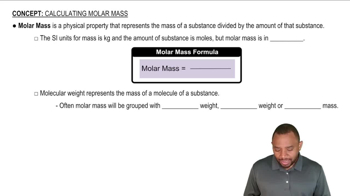
Molar mass is the mass of one mole of a substance, typically expressed in grams per mole (g/mol). It is calculated by summing the atomic masses of all atoms in a chemical formula. For ibuprofen (C13H18O2), the molar mass can be determined by adding the masses of 13 carbon (C), 18 hydrogen (H), and 2 oxygen (O) atoms, which is essential for converting between grams and moles.
Video consigliato:
Percorso guidato
02:11
Molar Mass Concept

Conversion from Mass to Moles

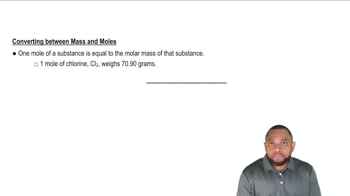
To find the number of moles from a given mass, the formula used is: moles = mass (g) / molar mass (g/mol). This relationship allows us to convert the mass of a substance into the number of moles, which is a fundamental concept in stoichiometry. In this case, we will convert the mass of the ibuprofen tablet (500 mg) into grams before applying this formula.
Video consigliato:
Percorso guidato
02:28
Mass and Moles Conversion

Stoichiometry

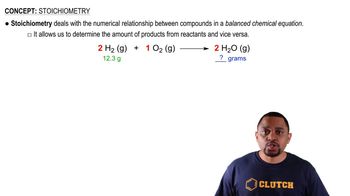
Stoichiometry is the area of chemistry that deals with the quantitative relationships between the reactants and products in a chemical reaction. It involves using balanced chemical equations to calculate the amounts of substances involved. In this question, stoichiometry is applied to determine how many moles of ibuprofen are present in a specific mass of the compound, which is crucial for understanding dosage and pharmacology.
Video consigliato:
Percorso guidato
01:16
Stoichiometry Concept
Pratica correlata
Domanda del libro di testo

If 2.0 mol CH3CH2CH2COOH, 2.0 mol C4H10, and 2.0 mol C6H6 are completely combusted in oxygen, which one produces the least? Explain.

385
views

Domanda del libro di testo

Very small semiconductor crystals, composed of approximately 1000 to 10,000 atoms, are called quantum dots. Quantum dots made of the semiconductor CdSe are now being used in electronic reader and tablet displays because they emit light efficiently and in multiple colors, depending on dot size. The density of CdSe is 5.82 g/cm3. (a) What is the mass of one 2.5-nm CdSe quantum dot?

418
views
Domanda del libro di testo

Very small semiconductor crystals, composed of approximately 1000 to 10,000 atoms, are called quantum dots. Quantum dots made of the semiconductor CdSe are now being used in electronic reader and tablet displays because they emit light efficiently and in multiple colors, depending on dot size. The density of CdSe is 5.82 g/cm3. (c) What is the mass of one 6.5-nm CdSe quantum dot?

335
views
Domanda del libro di testo

If 2.0 mol CH3CH2CH2COOH, 2.0 mol C4H10, and 2.0 mol C6H6 are completely combusted in oxygen, which one produces the largest number of moles of H2O?

452
views
Domanda del libro di testo
Calcium is an essential nutrient in our body. It is important for bone health. Four common calcium-containing supplements are calcium carbonate (CaCO3), calcium citrate (Ca3C12H10O14), calcium gluconate (CaC12H22O14), and calcium lactate (CaC6H10O6). Rank these calcium supplements in terms of the mass percentage of calcium they contain.
778
views