Ch.3 - Chemical Reactions and Reaction Stoichiometry
Brown - Chemistry: The Central Science 14th Edition
Brown14th EditionChemistry: The Central ScienceISBN: 9780134414232Non è quello che usi tu?Cambia libro di testo
Capitolo 3, Problema 73b

(b) Why are the amounts of products formed in a reaction determined only by the amount of the limiting reactant?

Guida verificata passo dopo passo
1
Identify the concept of a limiting reactant: In a chemical reaction, the limiting reactant is the substance that is completely consumed first, stopping the reaction from continuing because there is no more of this reactant to react with the other reactants.
Understand the stoichiometry of the reaction: The balanced chemical equation provides the mole ratio of reactants to products. This ratio is crucial in determining how much product can be formed from a given amount of reactant.
Determine the amount of product formed: Since the limiting reactant is completely used up, it dictates the maximum amount of product that can be formed. The other reactants may be in excess, but they cannot produce more product without the limiting reactant.
Calculate the theoretical yield: Using the stoichiometric coefficients from the balanced equation, calculate the amount of product that can be formed from the limiting reactant. This is known as the theoretical yield.
Recognize the practical implications: In practical terms, the limiting reactant determines the efficiency and cost-effectiveness of a reaction, as it limits the amount of product that can be obtained, regardless of the quantities of other reactants present.

Risposta video verificata per un problema simile:

Questa soluzione video è stata consigliata dai nostri tutor come utile per risolvere questo problema.
Durata del video:
2m

Concetti chiave

Ecco i concetti essenziali che devi comprendere per rispondere correttamente alla domanda.

Limiting Reactant

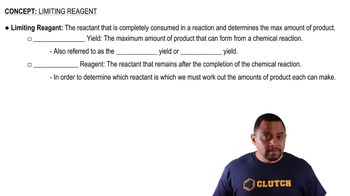
The limiting reactant is the substance in a chemical reaction that is completely consumed first, thus determining the maximum amount of product that can be formed. Once this reactant is used up, the reaction cannot proceed further, regardless of the amounts of other reactants present. Understanding which reactant is limiting is crucial for predicting the yield of products.
Video consigliato:
Percorso guidato
01:30
Limiting Reagent Concept

Stoichiometry

Stoichiometry is the branch of chemistry that deals with the quantitative relationships between the reactants and products in a chemical reaction. It involves using balanced chemical equations to calculate the amounts of substances consumed and produced. This concept is essential for determining how much product can be formed based on the amount of the limiting reactant.
Video consigliato:
Percorso guidato
01:16
Stoichiometry Concept

Reaction Completion

In a chemical reaction, completion refers to the point at which the reactants have been converted into products. The amount of product formed is directly related to the limiting reactant, as it dictates when the reaction stops. Understanding this concept helps clarify why the limiting reactant controls the overall yield of the reaction.
Video consigliato:
Percorso guidato
00:47
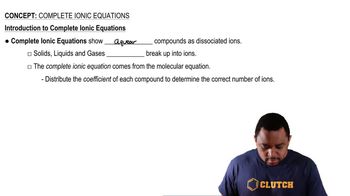
Complete Ionic Equations