
Ch.3 - Chemical Reactions and Reaction Stoichiometry
Brown - Chemistry: The Central Science 14th Edition
Brown14th EditionChemistry: The Central ScienceISBN: 9780134414232Non è quello che usi tu?Cambia libro di testo
Capitolo 3, Problema 14c

Balance the following equations: (c) MnO2(s) + HCl(aq) → MnCl2(s) + H2O(l) + Cl2(g)

Guida verificata passo dopo passo
1
Identify the elements involved in the reaction: Mn, O, H, Cl.
Write down the number of atoms of each element on both sides of the equation.
Balance the elements one at a time, starting with the element that appears in the fewest compounds. In this case, start with Mn.
Next, balance the oxygen atoms by adjusting the coefficients of H2O.
Finally, balance the hydrogen and chlorine atoms by adjusting the coefficients of HCl and Cl2.

Risposta video verificata per un problema simile:

Questa soluzione video è stata consigliata dai nostri tutor come utile per risolvere questo problema.
Durata del video:
1m

Concetti chiave

Ecco i concetti essenziali che devi comprendere per rispondere correttamente alla domanda.

Balancing Chemical Equations

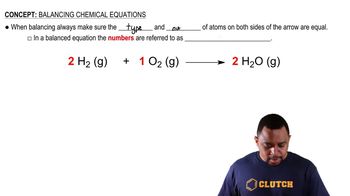
Balancing chemical equations involves ensuring that the number of atoms for each element is the same on both sides of the equation. This is based on the law of conservation of mass, which states that matter cannot be created or destroyed in a chemical reaction. To balance an equation, coefficients are adjusted in front of the chemical formulas to achieve equal atom counts.
Video consigliato:
Percorso guidato
01:32
Balancing Chemical Equations

Oxidation-Reduction Reactions

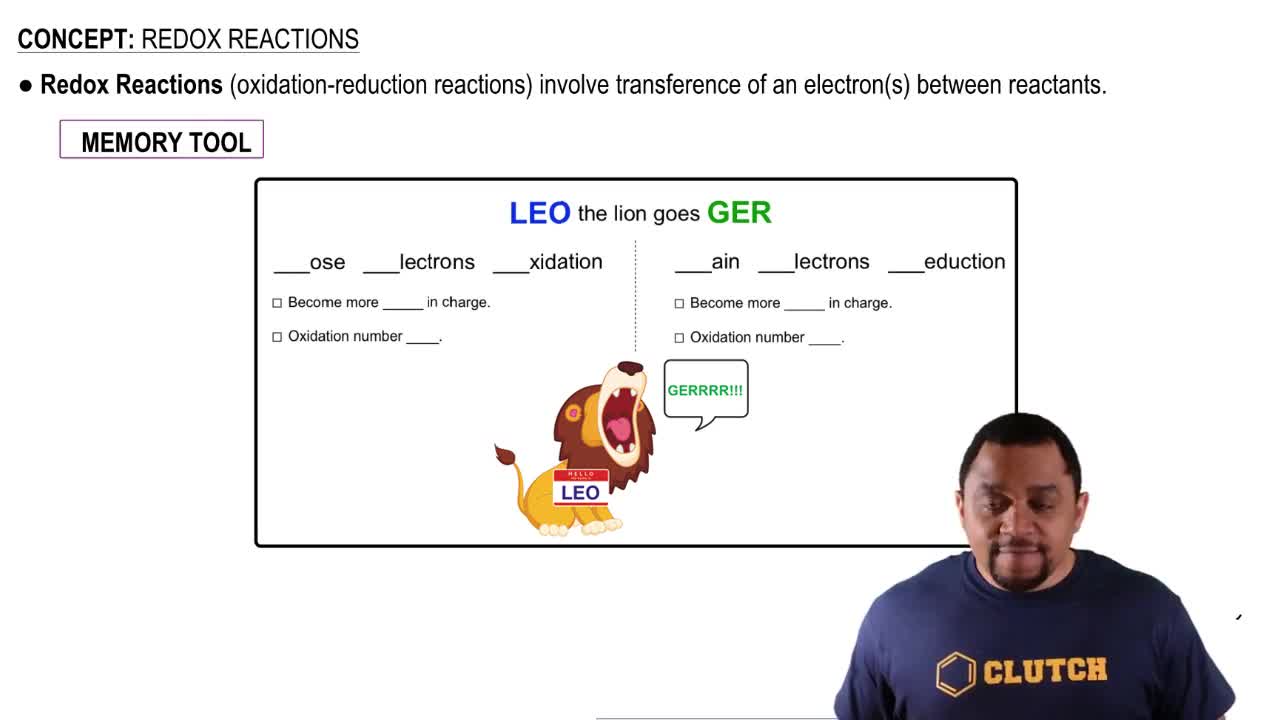
Oxidation-reduction (redox) reactions involve the transfer of electrons between species, resulting in changes in oxidation states. In the given equation, manganese (Mn) undergoes a change in oxidation state, indicating it is being reduced, while chlorine (Cl) is being oxidized. Understanding these processes is crucial for correctly balancing redox reactions.
Video consigliato:
Percorso guidato
01:53
Oxidation and Reduction Reactions

States of Matter in Chemical Reactions

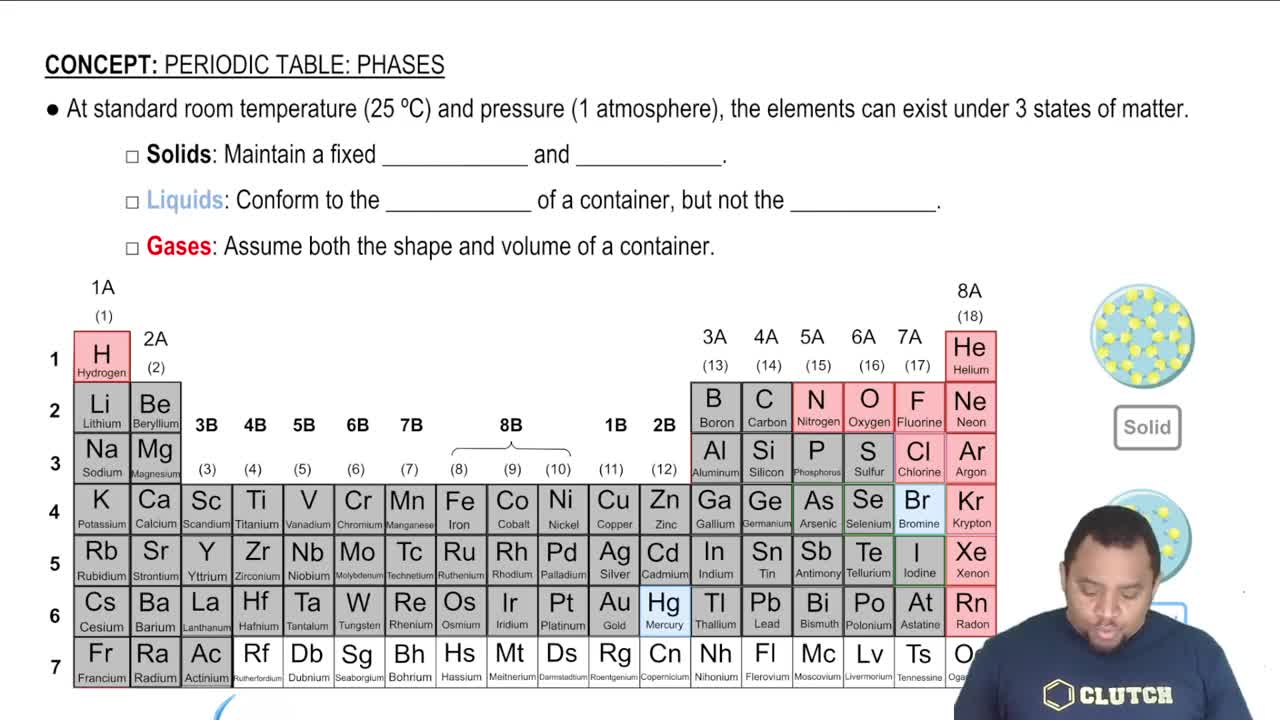
The states of matter (solid, liquid, gas, and aqueous) in a chemical equation provide important information about the physical state of the reactants and products. In the equation provided, MnO2 is a solid, HCl is aqueous, and Cl2 is a gas, which can influence reaction conditions and the balancing process. Recognizing these states helps in accurately interpreting and balancing the equation.
Video consigliato:
Percorso guidato
03:25
Element States of Matter
Pratica correlata
Domanda del libro di testo

Write balanced chemical equations to correspond to each of the following descriptions: (a) When sulfur trioxide gas reacts with water, a solution of sulfuric acid forms. (b) Boron sulfide, B2S3(s), reacts violently with water to form dissolved boric acid, H3BO3, and hydrogen sulfide gas.

879
views
Domanda del libro di testo

Balance the following equations: (d) KOH(aq) + H3PO4(aq) → K3PO4(aq) + H2O(l)

360
views
Domanda del libro di testo

Balance the following equations:

(a) CaS(s) + H2O(l) → Ca(HS2)2(aq) + Ca(OH)2(aq)

(b) NH3(g) + O2(g) → NO(g) + H2O(g)

(c) FeCl3(s) + Na2CO3(aq) → Fe2(CO3)3(s) + NaCl(aq)

(d) FeS2(s) + O2(g) → Fe2O3(s) + SO2(g)

520
views
Domanda del libro di testo

Write balanced chemical equations corresponding to each of the following descriptions: (a) Potassium cyanide reacts with an aqueous solution of sulfuric acid to form hydrogen cyanide gas. (b) When an aqueous solution of ammonium nitrite (NH4NO2) reacts with an aqueous solution of potassium hydroxide, ammonia gas, water and metal nitrate is formed. (c) When hydrogen gas is passed over solid hot iron(III) oxide, the resulting reaction produces iron and gaseous water. (d) When liquid ethanoic acid (CH3COOH) is combusted, carbon dioxide and water are formed.

962
views
Domanda del libro di testo

Balance the following equations: (d) Na2CO3(aq) + HCl(aq) → NaCl(aq) + H2O(l) + CO2(g)

371
views
Domanda del libro di testo

Balance the following equations: (a) CF4(l) + Br2(g) → CBr4(l) + F2(g) (b) Cu(s) + HNO3(aq) → Cu(NO3)2(aq) + NO2(g) + H2O(l)

451
views