What is the molecular formula of each of the following compounds? (a) empirical formula CH, molar mass 5 78.0 g/mol (b) empirical formula NH2Cl, molar mass = 51.5 g/mol
Ch.3 - Chemical Reactions and Reaction Stoichiometry
Brown14th EditionChemistry: The Central ScienceISBN: 9780134414232Non è quello che usi tu?Cambia libro di testo
Tutti i libri di testo
Brown 14th Edition
Ch.3 - Chemical Reactions and Reaction Stoichiometry
Problema 48c
Brown 14th Edition
Ch.3 - Chemical Reactions and Reaction Stoichiometry
Problema 48cCapitolo 3, Problema 48c
Determine the empirical formulas of the compounds with the following compositions by mass: (c) 60.0% C, 4.4% H, and the remainder O
Guida verificata passo dopo passo1
Identify the mass percentages of each element: 60.0% C, 4.4% H, and the remainder O. Calculate the percentage of O by subtracting the sum of the percentages of C and H from 100%.
Assume a 100 g sample of the compound, which means you have 60.0 g of C, 4.4 g of H, and the remainder in grams of O.
Convert the masses of each element to moles by dividing by their respective atomic masses: C (12.01 g/mol), H (1.008 g/mol), and O (16.00 g/mol).
Determine the mole ratio of the elements by dividing each element's mole value by the smallest number of moles calculated in the previous step.
If necessary, multiply the mole ratios by a whole number to obtain the smallest whole number ratio for the empirical formula.

Risposta video verificata per un problema simile:
Questa soluzione video è stata consigliata dai nostri tutor come utile per risolvere questo problema.
Durata del video:
1mConcetti chiave
Ecco i concetti essenziali che devi comprendere per rispondere correttamente alla domanda.
Empirical Formula
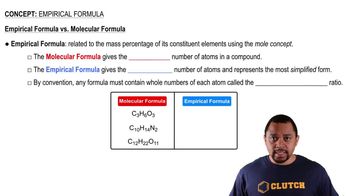
The empirical formula of a compound represents the simplest whole-number ratio of the elements present in that compound. It is derived from the mass percentages of each element, which are converted to moles and then simplified to the smallest integer ratio. This formula provides essential information about the composition of the compound without indicating the actual number of atoms in a molecule.
Video consigliato:
Percorso guidato
Empirical vs Molecular Formula
Mole Concept
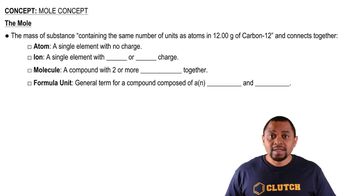
The mole concept is a fundamental principle in chemistry that relates the mass of a substance to the number of particles it contains. One mole of any substance contains Avogadro's number (approximately 6.022 x 10²³) of entities, whether they are atoms, molecules, or ions. This concept is crucial for converting mass percentages into moles, which is necessary for determining the empirical formula.
Video consigliato:
Percorso guidato
Mole Concept
Mass Percent Composition
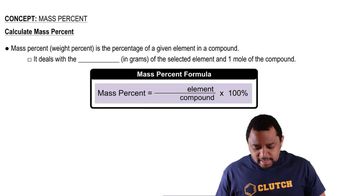
Mass percent composition refers to the percentage by mass of each element in a compound. It is calculated by dividing the mass of each element in a sample by the total mass of the sample and multiplying by 100. Understanding mass percent composition is essential for converting the given percentages into moles, which is the first step in finding the empirical formula of a compound.
Video consigliato:
Percorso guidato
Mass Percent Calculation
Pratica correlata
Domanda del libro di testo
870
views
Domanda del libro di testo
The compound XCl4 contains 75.0% Cl by mass. What is the element X?
1449
views
Domanda del libro di testo
Determine the empirical formulas of the compounds with the following compositions by mass: (b) 57.5% Na, 40.0% O, and 2.5% H (c) 41.1% N, 11.8% H, and the remainder S
723
views
Domanda del libro di testo
Determine the empirical formulas of the compounds with the following compositions by mass: (a) 74.0% C, 8.7% H, and 17.3% N
501
views
Domanda del libro di testo
A compound whose empirical formula is XF3 consists of 65% F by mass. What is the atomic mass of X?
2720
views
Domanda del libro di testo
Determine the empirical formulas of the compounds with the following compositions by mass: (a) 42.1% Na, 18.9% P, and 39.0% O (b) 18.7% Li, 16.3% C, and 65.0% O
1243
views