
Ch.3 - Chemical Reactions and Reaction Stoichiometry
Brown - Chemistry: The Central Science 14th Edition
Brown14th EditionChemistry: The Central ScienceISBN: 9780134414232Non è quello che usi tu?Cambia libro di testo
Capitolo 3, Problema 7d1

Nitrogen 1N22 and hydrogen 1H22 react to form ammonia 1NH32. Consider the mixture of N2 and H2 shown in the accompanying diagram. The blue spheres represent N, and the white ones represent H. (d) Are any reactant molecules left over, based on the diagram?

Guida verificata passo dopo passo
1
Step 1: Identify the balanced chemical equation for the reaction. The balanced chemical equation for the formation of ammonia from nitrogen and hydrogen is: N2 + 3H2 -> 2NH3. This means that one molecule of nitrogen reacts with three molecules of hydrogen to form two molecules of ammonia.
Step 2: Analyze the diagram. Count the number of nitrogen (N2) and hydrogen (H2) molecules present in the diagram.
Step 3: Compare the ratio of nitrogen to hydrogen molecules in the diagram with the ratio in the balanced chemical equation. If the ratio in the diagram is the same as in the balanced equation, then all reactant molecules will be used up in the reaction.
Step 4: If the ratio in the diagram is not the same as in the balanced equation, then some reactant molecules will be left over after the reaction. The reactant that is present in excess (more than required by the balanced equation) will be the one left over.
Step 5: Determine which reactant, if any, is left over based on your comparison in steps 3 and 4.

Risposta video verificata per un problema simile:

Questa soluzione video è stata consigliata dai nostri tutor come utile per risolvere questo problema.
Durata del video:
4m

Concetti chiave

Ecco i concetti essenziali che devi comprendere per rispondere correttamente alla domanda.

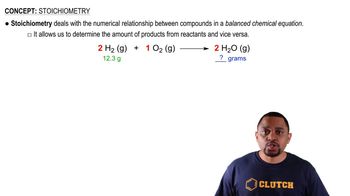
Stoichiometry

Stoichiometry is the branch of chemistry that deals with the quantitative relationships between the reactants and products in a chemical reaction. It allows us to determine how much of each substance is needed or produced based on the balanced chemical equation. For the reaction of nitrogen and hydrogen to form ammonia, understanding the mole ratios is essential to assess whether all reactants are consumed.
Video consigliato:
Percorso guidato
01:16
Stoichiometry Concept

Molecular Representation

Molecular representation involves visualizing molecules using models or diagrams, which can help in understanding the composition and structure of compounds. In this question, the blue and white spheres represent nitrogen and hydrogen atoms, respectively. Analyzing the diagram allows us to see how many molecules of each reactant are present and whether they can fully react to form ammonia.
Video consigliato:
Percorso guidato
02:38
Molecular Polarity

Limiting Reactant

The limiting reactant is the substance that is completely consumed first in a chemical reaction, thus determining the maximum amount of product that can be formed. Identifying the limiting reactant is crucial for predicting whether any reactant molecules will remain after the reaction. In the context of the given question, determining which reactant is limiting will help answer whether any nitrogen or hydrogen molecules are left over.
Video consigliato:
Percorso guidato
01:30
Limiting Reagent Concept
Pratica correlata
Domanda del libro di testo

The following diagram represents a high-temperature reaction between CH4 and H2O. Based on this reaction, find how many moles of each product can be obtained starting with 4.0 mol CH4. Based on this reaction, how many moles of H2 can be obtained starting with 4.0 mol CH4?

404
views
Domanda del libro di testo

The following diagram represents a high-temperature reaction between CH4 and H2O. Based on this reaction, find how many moles of each product can be obtained starting with 4.0 mol CH4.

Based on this reaction, find how many moles of CO can be obtained starting with 4.0 mol CH4?

904
views
1
rank
Domanda del libro di testo

Nitrogen 1N22 and hydrogen 1H22 react to form ammonia 1NH32. Consider the mixture of N2 and H2 shown in the accompanying diagram. The blue spheres represent N, and the white ones represent H. (a) Write the balanced chemical equation for the reaction.

525
views
1
rank
Domanda del libro di testo

Nitrogen 1N22 and hydrogen 1H22 react to form ammonia 1NH32. Consider the mixture of N2 and H2 shown in the accompanying diagram. The blue spheres represent N, and the white ones represent H. (d) If so, how many of which type are left over?

How many N2 molecules are left over?

461
views
Domanda del libro di testo

Nitrogen monoxide and oxygen react to form nitrogen dioxide. Consider the mixture of NO and O2 shown in the accompanying diagram. The blue spheres represent N, and the red ones represent O. (a) How many molecules of NO2 can be formed, assuming the reaction goes to completion?

1381
views
Domanda del libro di testo

Nitrogen monoxide and oxygen react to form nitrogen dioxide. Consider the mixture of NO and O2 shown in the accompanying diagram. The blue spheres represent N, and the red ones represent O. (c) If the actual yield of the reaction was 75% instead of 100%, how many molecules of each kind would be present after the reaction was over?

1043
views