


Ch.3 - Chemical Reactions and Reaction Stoichiometry
Brown - Chemistry: The Central Science 14th Edition
Brown14th EditionChemistry: The Central ScienceISBN: 9780134414232Non è quello che usi tu?Cambia libro di testo
Capitolo 3, Problema 80a

One of the steps in the commercial process for converting ammonia to nitric acid is the conversion of NH3 to NO: 4 NH31g2 + 5 O21g2¡4 NO1g2 + 6 H2O1g2 In a certain experiment, 2.00 g of NH3 reacts with 2.50 g of O2. (a) Which is the limiting reactant?

Guida verificata passo dopo passo
1
Step 1: Write down the balanced chemical equation. In this case, it is already given: 4 NH3(g) + 5 O2(g) → 4 NO(g) + 6 H2O(g)
Step 2: Calculate the number of moles of each reactant. The molar mass of NH3 is approximately 17 g/mol and the molar mass of O2 is approximately 32 g/mol. So, divide the given mass of each reactant by its molar mass to find the number of moles.
Step 3: Determine the stoichiometric ratio from the balanced chemical equation. In this case, it is 4 moles of NH3 to 5 moles of O2.
Step 4: Compare the ratio of the number of moles of each reactant to the stoichiometric ratio. The reactant that is less than or equal to its stoichiometric ratio is the limiting reactant.
Step 5: If it's not clear which reactant is the limiting one, calculate the amount of product that each reactant could produce. The reactant that produces the least amount of product is the limiting reactant.

Risposta video verificata per un problema simile:

Questa soluzione video è stata consigliata dai nostri tutor come utile per risolvere questo problema.
Durata del video:
2m

Concetti chiave

Ecco i concetti essenziali che devi comprendere per rispondere correttamente alla domanda.

Stoichiometry

Stoichiometry is the calculation of reactants and products in chemical reactions based on the balanced chemical equation. It allows chemists to determine the proportions of substances involved in a reaction, which is essential for identifying limiting reactants. In this case, stoichiometry will help calculate how much NH3 and O2 are needed to produce NO and H2O.
Video consigliato:
Percorso guidato
01:16
Stoichiometry Concept

Limiting Reactant

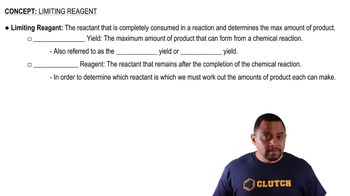
The limiting reactant is the substance that is completely consumed first in a chemical reaction, thus determining the maximum amount of product that can be formed. Identifying the limiting reactant is crucial for predicting the yield of products. In this experiment, comparing the mole ratios of NH3 and O2 will reveal which reactant limits the formation of NO.
Video consigliato:
Percorso guidato
01:30
Limiting Reagent Concept

Molar Mass

Molar mass is the mass of one mole of a substance, typically expressed in grams per mole (g/mol). It is essential for converting between grams and moles, which is necessary for stoichiometric calculations. In this question, calculating the molar masses of NH3 and O2 will allow for the determination of the number of moles present, facilitating the identification of the limiting reactant.
Video consigliato:
Percorso guidato
02:11
Molar Mass Concept
Pratica correlata
Domanda del libro di testo

Solutions of sodium carbonate and silver nitrate react to form solid silver carbonate and a solution of sodium nitrate. A solution containing 3.50 g of sodium carbonate is mixed with one containing 5.00 g of silver nitrate. How many grams of sodium carbonate are present after the reaction is complete? How many grams of sodium nitrate are present after the reaction is complete?

1557
views
1
rank
Domanda del libro di testo

Aluminum hydroxide reacts with sulfuric acid as follows: 2 Al1OH231s2 + 3 H2SO41aq2¡Al21SO4231aq2 + 6 H2O1l2 How many moles of the excess reactant remain after the completion of the reaction?

624
views
Domanda del libro di testo

One of the steps in the commercial process for converting ammonia to nitric acid is the conversion of NH3 to NO: 4 NH3(g) + 5 O2(g) → 4 NO(g) + 6 H2O(g) In a certain experiment, 2.00 g of NH3 reacts with 2.50 g of O2. (d) Show that your calculations in parts (b) and (c) are consistent with the law of conservation of mass.

2103
views
Domanda del libro di testo

The fizz produced when an Alka-Seltzer tablet is dissolved in water is due to the reaction between sodium bicarbonate 1NaHCO32 and citric acid 1H3C6H5O72: 3 NaHCO31aq2 + H3C6H5O71aq2¡ 3 CO21g2 + 3H2O1l2 + Na3C6H5O71aq2 In a certain experiment 1.00 g of sodium bicarbonate and 1.00 g of citric acid are allowed to react. (a) Which is the limiting reactant? (b) How many grams of carbon dioxide form? (c) How many grams of the excess reactant remain after the limiting reactant is completely consumed?

1068
views
1
comments
Domanda del libro di testo

One of the steps in the commercial process for converting ammonia to nitric acid is the conversion of NH3 to NO: 4 NH31g2 + 5 O21g2¡4 NO1g2 + 6 H2O1g2 In a certain experiment, 2.00 g of NH3 reacts with 2.50 g of O2. (c) How many grams of the excess reactant remain after the limiting reactant is completely consumed?

639
views
Domanda del libro di testo

Aluminum hydroxide reacts with sulfuric acid as follows: 2 Al1OH231s2 + 3 H2SO41aq2¡Al21SO4231aq2 + 6 H2O1l2 How many moles of Al21SO423 can form under these conditions?

740
views