


Ch.3 - Chemical Reactions and Reaction Stoichiometry
Brown - Chemistry: The Central Science 14th Edition
Brown14th EditionChemistry: The Central ScienceISBN: 9780134414232Non è quello che usi tu?Cambia libro di testo
Capitolo 3, Problema 105c3

When a mixture of 10.0 g of acetylene (C2H2) and 10.0 g of oxygen (O2) is ignited, the resulting combustion reaction produces CO2 and H2O. (c) How many grams of CO2 and H2O are present after the reaction is complete?

Guida verificata passo dopo passo
1
Determine the molar mass of acetylene (C2H2) and oxygen (O2).
Calculate the moles of acetylene and oxygen initially present using their respective molar masses.
Write the balanced chemical equation for the combustion of acetylene: 2 C2H2 + 5 O2 ightarrow 4 CO2 + 2 H2O.
Using stoichiometry, determine the limiting reactant by comparing the mole ratio from the balanced equation with the moles of each reactant calculated.
Calculate the moles of CO2 produced based on the moles of the limiting reactant, then convert these moles of CO2 to grams using the molar mass of CO2.

Risposta video verificata per un problema simile:

Questa soluzione video è stata consigliata dai nostri tutor come utile per risolvere questo problema.
Durata del video:
5m

Concetti chiave

Ecco i concetti essenziali che devi comprendere per rispondere correttamente alla domanda.

Stoichiometry

Stoichiometry is the branch of chemistry that deals with the quantitative relationships between the reactants and products in a chemical reaction. It allows us to calculate the amounts of substances consumed and produced in a reaction based on balanced chemical equations. In this case, understanding the stoichiometric ratios of acetylene and oxygen will help determine how much carbon dioxide is produced.
Video consigliato:
Percorso guidato
01:16
Stoichiometry Concept

Combustion Reactions

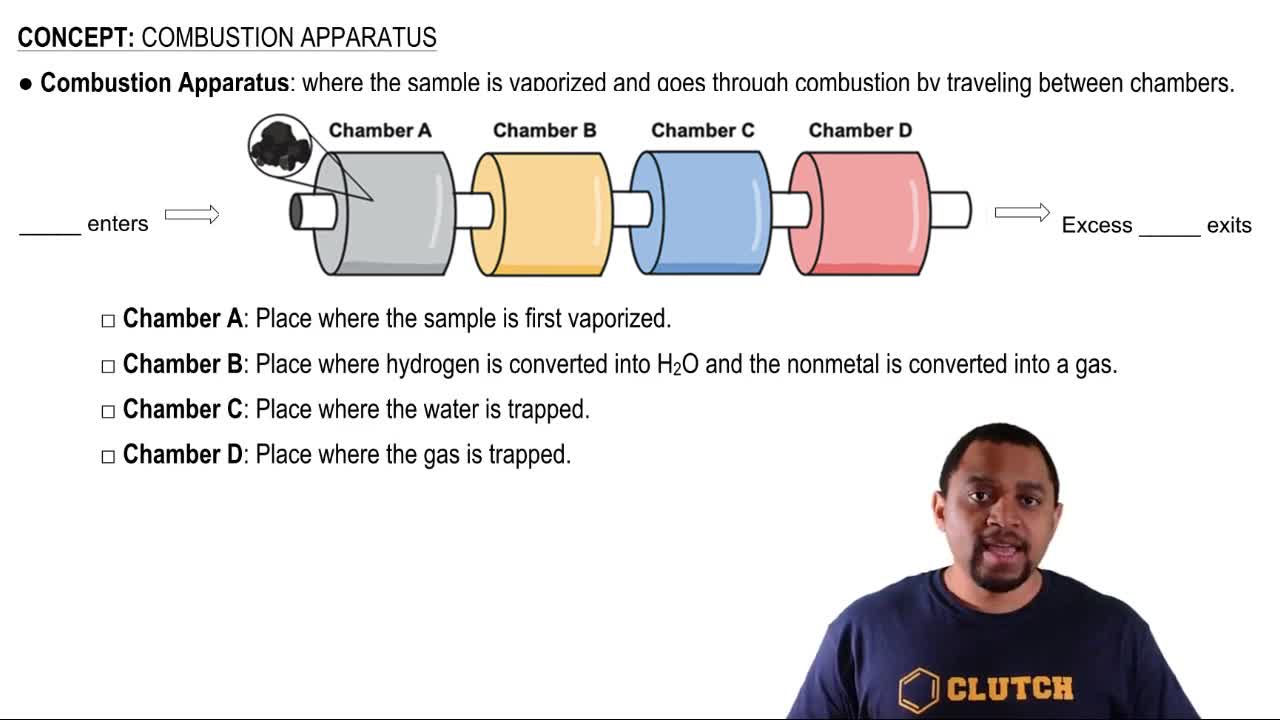
Combustion reactions are exothermic reactions that occur when a substance reacts with oxygen, producing heat and light. In the case of acetylene (C2H2), it combusts in the presence of oxygen to form carbon dioxide (CO2) and water (H2O). Recognizing the products of the combustion of acetylene is essential for calculating the mass of CO2 produced.
Video consigliato:
Percorso guidato
02:24
Combustion Apparatus

Molar Mass

Molar mass is the mass of one mole of a substance, typically expressed in grams per mole (g/mol). It is crucial for converting between grams of a substance and moles, which are used in stoichiometric calculations. For this problem, knowing the molar masses of acetylene, oxygen, carbon dioxide, and water will facilitate the conversion of the initial masses into moles, allowing for the determination of the final mass of CO2 produced.
Video consigliato:
Percorso guidato
02:11
Molar Mass Concept