
A key step in balancing chemical equations is correctly identifying the formulas of the reactants and products. For example, consider the reaction between calcium oxide, CaO(s), and H2O1l2 to form aqueous calcium hydroxide. (b) Is it possible to balance the equation if you incorrectly identify the product as CaOH1aq2, and if so, what is the equation?
Brown 14th Edition
Ch.3 - Chemical Reactions and Reaction Stoichiometry
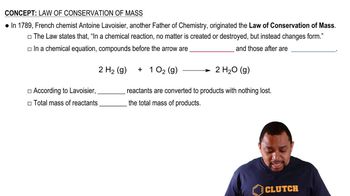
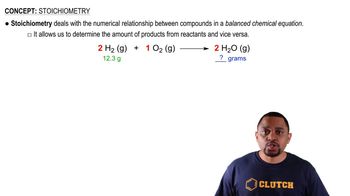
Problema 9bWrite 'true' or 'false' for each statement. (b) If the reaction 2 O3(g) → 3 O2(g) goes to completion and all O3 is converted to O2, then the mass of O3 at the beginning of the reaction must be the same as the mass of O2 at the end of the reaction.
Guida verificata passo dopo passo
Risposta video verificata per un problema simile:
Concetti chiave
Law of Conservation of Mass
Stoichiometry
Chemical Reaction Completion
Write 'true' or 'false' for each statement. (a) We balance chemical equations as we do because energy must be conserved.
Nitrogen monoxide and oxygen react to form nitrogen dioxide. Consider the mixture of NO and O2 shown in the accompanying diagram. The blue spheres represent N, and the red ones represent O. (a) How many molecules of NO2 can be formed, assuming the reaction goes to completion?
Balance the following equations: (c) Al(OH)3(s) + H2SO4(l) → Al2(SO4)3(s) + H2O(l)
Nitrogen monoxide and oxygen react to form nitrogen dioxide. Consider the mixture of NO and O2 shown in the accompanying diagram. The blue spheres represent N, and the red ones represent O. (c) If the actual yield of the reaction was 75% instead of 100%, how many molecules of each kind would be present after the reaction was over?