
Ch.4 - Reactions in Aqueous Solution
Brown - Chemistry: The Central Science 14th Edition
Brown14th EditionChemistry: The Central ScienceISBN: 9780134414232Non è quello che usi tu?Cambia libro di testo
Capitolo 4, Problema 98b

Bronze is a solid solution of Cu(s) and Sn(s); solutions of metals like this that are solids are called alloys. There is a range of compositions over which the solution is considered a bronze. Bronzes are stronger and harder than either copper or tin alone. (b) Based on part (a), calculate the concentration of the solute metal in the alloy in units of molarity, assuming a density of 7.9 g/cm3.

Guida verificata passo dopo passo
1
Identify the solute and solvent in the bronze alloy. Typically, the solute is the component present in a smaller amount, which is tin (Sn) in this case.
Determine the mass percentage or composition of tin in the bronze alloy. This information is necessary to calculate the concentration.
Convert the mass of tin to moles using its molar mass. The molar mass of tin (Sn) is approximately 118.71 g/mol.
Calculate the volume of the alloy using its density. Use the formula: \( \text{Volume} = \frac{\text{Mass}}{\text{Density}} \). Assume a sample mass if not provided.
Calculate the molarity of tin in the alloy using the formula: \( \text{Molarity} = \frac{\text{Moles of solute}}{\text{Volume of solution in liters}} \).

Risposta video verificata per un problema simile:

Questa soluzione video è stata consigliata dai nostri tutor come utile per risolvere questo problema.
Durata del video:
3m

Concetti chiave

Ecco i concetti essenziali che devi comprendere per rispondere correttamente alla domanda.

Alloys and Solid Solutions

Alloys are mixtures of two or more metals, where the resulting material exhibits properties different from the individual components. In the case of bronze, which is an alloy of copper (Cu) and tin (Sn), the solid solution allows for enhanced strength and hardness compared to pure metals. Understanding the nature of alloys is crucial for analyzing their properties and applications.
Video consigliato:
Percorso guidato
01:31
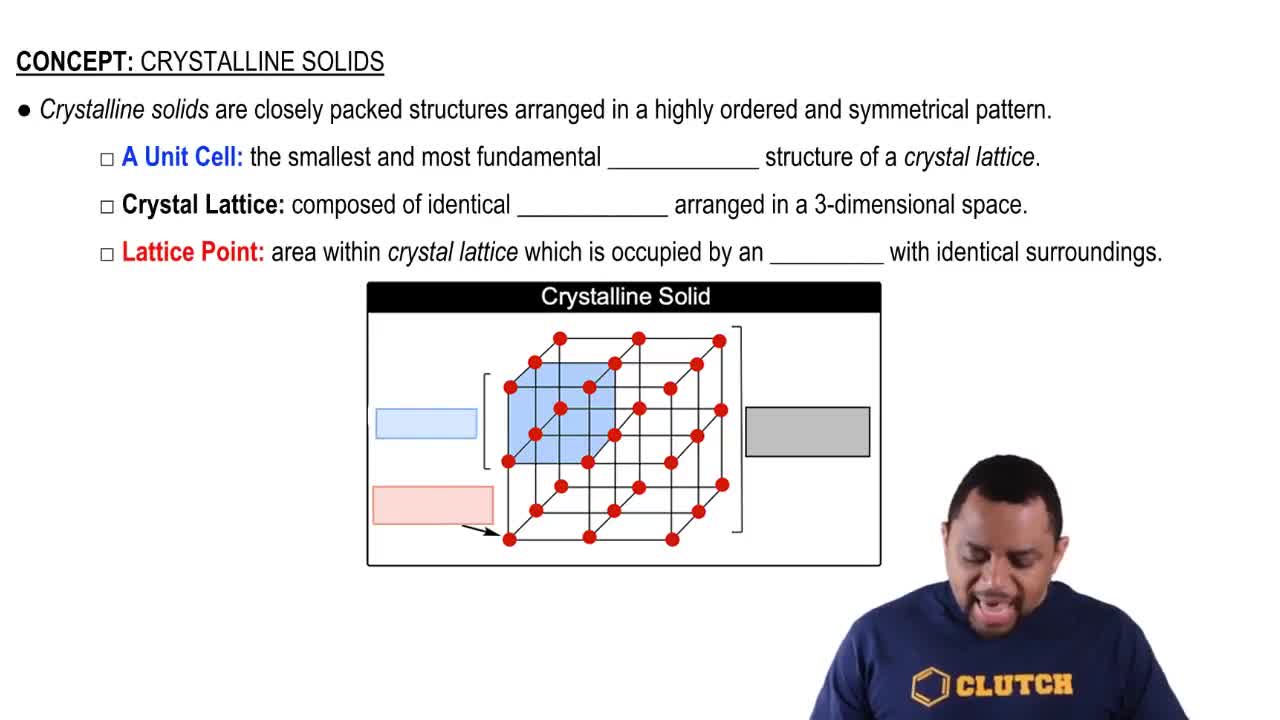
Crystalline Solids Structure

Molarity

Molarity is a measure of concentration defined as the number of moles of solute per liter of solution. It is expressed in units of moles per liter (mol/L). To calculate molarity, one must know the mass of the solute, its molar mass, and the total volume of the solution. This concept is essential for quantifying the concentration of components in a mixture, such as in the case of an alloy.
Video consigliato:

Density and Volume Calculations

Density is defined as mass per unit volume and is a critical property for converting between mass and volume. In this context, the density of the bronze alloy (7.9 g/cm³) can be used to determine the volume of the alloy when the mass is known. Understanding how to manipulate density in calculations is vital for determining the concentration of solutes in solutions, including alloys.
Video consigliato:
Percorso guidato
01:56
Density Concepts
Pratica correlata
Domanda del libro di testo

The commercial production of nitric acid involves the following chemical reactions:

4 NH3(g) + 5 O2(g) → 4 NO(g) + 6 H2O(g)

2 NO(g) + O2(g) → 2 NO2(g)

3 NO2(g) + H2O(l) → 2 HNO3(aq) + NO(g)

(c) How many grams of ammonia must you start with to make 1000.0 L of a 0.150 M aqueous solution of nitric acid? Assume all the reactions give 100% yield.

1255
views
Domanda del libro di testo

Neurotransmitters are molecules that are released by nerve cells to other cells in our bodies, and are needed for muscle motion, thinking, feeling, and memory. Dopamine is a common neurotransmitter in the human brain. (c) Experiments with rats show that if rats are dosed with 3.0 mg/kg of cocaine (that is, 3.0 mg cocaine per kg of animal mass), the concentration of dopamine in their brains increases by 0.75 mM after 60 seconds. Calculate how many molecules of dopamine would be produced in a rat (average brain volume 5.00 mm3) after 60 seconds of a 3.0 mg/kg dose of cocaine.

487
views
Domanda del libro di testo

Bronze is a solid solution of Cu(s) and Sn(s); solutions of metals like this that are solids are called alloys. There is a range of compositions over which the solution is considered a bronze. Bronzes are stronger and harder than either copper or tin alone. (c) Suggest a reaction that you could do to remove all the tin from this bronze to leave a pure copper sample. Justify your reasoning.

946
views
Domanda del libro di testo

Consider the following reagents: zinc, copper, mercury (density 13.6 g/mL), silver nitrate solution, nitric acid solution. (a) Given a 500-mL Erlenmeyer flask and a balloon, can you combine two or more of the foregoing reagents to initiate a chemical reaction that will inflate the balloon? Write a balanced chemical equation to represent this process. What is the identity of the substance that inflates the balloon?

373
views