
Ch.4 - Reactions in Aqueous Solution
Brown - Chemistry: The Central Science 14th Edition
Brown14th EditionChemistry: The Central ScienceISBN: 9780134414232Non è quello che usi tu?Cambia libro di testo
Capitolo 4, Problema 102a

Citric acid, C6H8O7, is a triprotic acid. It occurs naturally in citrus fruits like lemons and has applications in food flavouring and preservatives. A solution containing an unknown concentration of the acid is titrated with KOH. It requires 23.20 mL of 0.500 M KOH solution to titrate all three acidic protons in 100.00 mL of the citric acid solution. Write a balanced net ionic equation for the neutralization reaction.

Guida verificata passo dopo passo
1
Identify the reactants involved in the neutralization reaction. Citric acid (C6H8O7) is a triprotic acid, meaning it can donate three protons (H+), and KOH (potassium hydroxide) is a strong base that provides OH- (hydroxide ions) when dissolved in water.
Write the chemical formulas for the dissociation of citric acid and KOH in water. Citric acid partially dissociates to release H+ ions, and KOH completely dissociates into K+ and OH- ions.
Set up the net ionic equation by combining the H+ ions from citric acid and the OH- ions from KOH. The reaction between H+ and OH- forms water (H2O).
Balance the net ionic equation. Since citric acid can donate three protons, and each KOH molecule provides one OH-, you need three OH- ions to neutralize one molecule of citric acid. Therefore, the balanced net ionic equation will involve three OH- ions reacting with three H+ ions to form three water molecules.
Write the final balanced net ionic equation: 3H+ + 3OH- -> 3H2O.

Risposta video verificata per un problema simile:

Questa soluzione video è stata consigliata dai nostri tutor come utile per risolvere questo problema.
Durata del video:
7m

Concetti chiave

Ecco i concetti essenziali che devi comprendere per rispondere correttamente alla domanda.

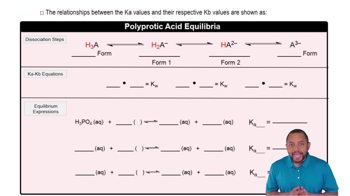
Triprotic Acids

Triprotic acids, like citric acid, can donate three protons (H+) per molecule during a reaction. This characteristic affects their behavior in titrations, as each proton can react with a base, leading to multiple equivalence points. Understanding the nature of triprotic acids is essential for determining the stoichiometry of the neutralization reaction.
Video consigliato:
Percorso guidato
6:47
Triprotic Acid Equilibrium

Neutralization Reaction

A neutralization reaction occurs when an acid reacts with a base to form water and a salt. In this case, citric acid reacts with potassium hydroxide (KOH) to neutralize its acidic protons. The balanced net ionic equation represents the essential species involved in the reaction, excluding spectator ions, and is crucial for understanding the overall chemical process.
Video consigliato:
Percorso guidato
05:56
Lewis Dot Structures: Neutral Compounds

Titration and Molarity

Titration is a quantitative analytical method used to determine the concentration of an unknown solution by reacting it with a solution of known concentration. Molarity, defined as moles of solute per liter of solution, is key in calculating the amount of acid neutralized by the base. In this scenario, the volume and molarity of KOH allow for the determination of the moles of citric acid present in the solution.
Video consigliato:
Pratica correlata
Domanda del libro di testo

Neurotransmitters are molecules that are released by nerve cells to other cells in our bodies, and are needed for muscle motion, thinking, feeling, and memory. Dopamine is a common neurotransmitter in the human brain. (c) Experiments with rats show that if rats are dosed with 3.0 mg/kg of cocaine (that is, 3.0 mg cocaine per kg of animal mass), the concentration of dopamine in their brains increases by 0.75 mM after 60 seconds. Calculate how many molecules of dopamine would be produced in a rat (average brain volume 5.00 mm3) after 60 seconds of a 3.0 mg/kg dose of cocaine.

487
views
Domanda del libro di testo

Hard water contains Ca2+, Mg2+, and Fe2+, which interfere with the action of soap and leave an insoluble coating on the insides of containers and pipes when heated. Water softeners replace these ions with Na+. Keep in mind that charge balance must be maintained. (b) If the sodium is added to the water softener in the form of NaCl, how many grams of sodium chloride are needed?

843
views
Domanda del libro di testo

Citric acid, C6H8O7, is a triprotic acid. It occurs naturally in citrus fruits like lemons and has applications in food flavouring and preservatives. A solution containing an unknown concentration of the acid is titrated with KOH. It requires 23.20 mL of 0.500 M KOH solution to titrate all three acidic protons in 100.00 mL of the citric acid solution. Calculate the molarity of the citric acid solution.

2019
views
Domanda del libro di testo

Suppose you have 3.00 g of powdered zinc metal, 3.00g of powdered silver metal and 500.0 mL of a 0.2 M copper(II) nitrate solution. (a) Which metal will react with the copper(II) nitrate solution?

330
views
Domanda del libro di testo
(c) If 18.65 mL of the caesium hydroxide solution was needed to neutralize a 42.3 mL aliquot of the hydroiodic acid solution, what is the concentration (molarity) of the acid?
492
views
Domanda del libro di testo

Hard water contains Ca2+, Mg2+, and Fe2+, which interfere with the action of soap and leave an insoluble coating on the insides of containers and pipes when heated. Water softeners replace these ions with Na+. Keep in mind that charge balance must be maintained. (a) If 1500 L of hard water contains 0.020 M Ca2+ and 0.0040 M Mg2+, how many moles of Na+ are needed to replace these ions?

1566
views