Ch.4 - Reactions in Aqueous Solution
Brown - Chemistry: The Central Science 14th Edition
Brown14th EditionChemistry: The Central ScienceISBN: 9780134414232Non è quello che usi tu?Cambia libro di testo
Capitolo 4, Problema 24

Identify the precipitate (if any) that forms when the following solutions are mixed, and write a balanced equation for each reaction. (a) NH4I and CuCl2 (b) LiOH and MnCl2 (c) K3PO4 and CoSO4

Guida verificata passo dopo passo
1
insert step 1> Identify the ions present in each solution: LiOH dissociates into Li^+ and OH^- ions, while MnCl2 dissociates into Mn^2+ and Cl^- ions.
insert step 2> Determine the possible combinations of cations and anions that could form a precipitate: Li^+ with Cl^- and Mn^2+ with OH^-.
insert step 3> Use solubility rules to determine if any of these combinations form an insoluble compound: LiCl is soluble, but Mn(OH)2 is generally insoluble in water.
insert step 4> Write the balanced chemical equation for the formation of the precipitate: Mn^2+ (aq) + 2 OH^- (aq) -> Mn(OH)2 (s).
insert step 5> Conclude that Mn(OH)2 is the precipitate formed when LiOH and MnCl2 solutions are mixed.

Risposta video verificata per un problema simile:

Questa soluzione video è stata consigliata dai nostri tutor come utile per risolvere questo problema.
Durata del video:
5m

Concetti chiave

Ecco i concetti essenziali che devi comprendere per rispondere correttamente alla domanda.

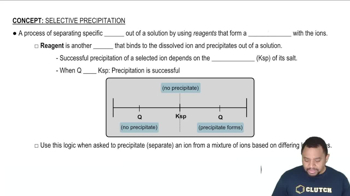
Precipitation Reactions

Precipitation reactions occur when two soluble salts react in solution to form an insoluble product, known as a precipitate. This process is driven by the formation of a compound that cannot remain dissolved in the solvent, leading to the separation of solid material from the liquid. Understanding solubility rules helps predict whether a precipitate will form when two solutions are mixed.
Video consigliato:
Percorso guidato
01:53
Selective Precipitation

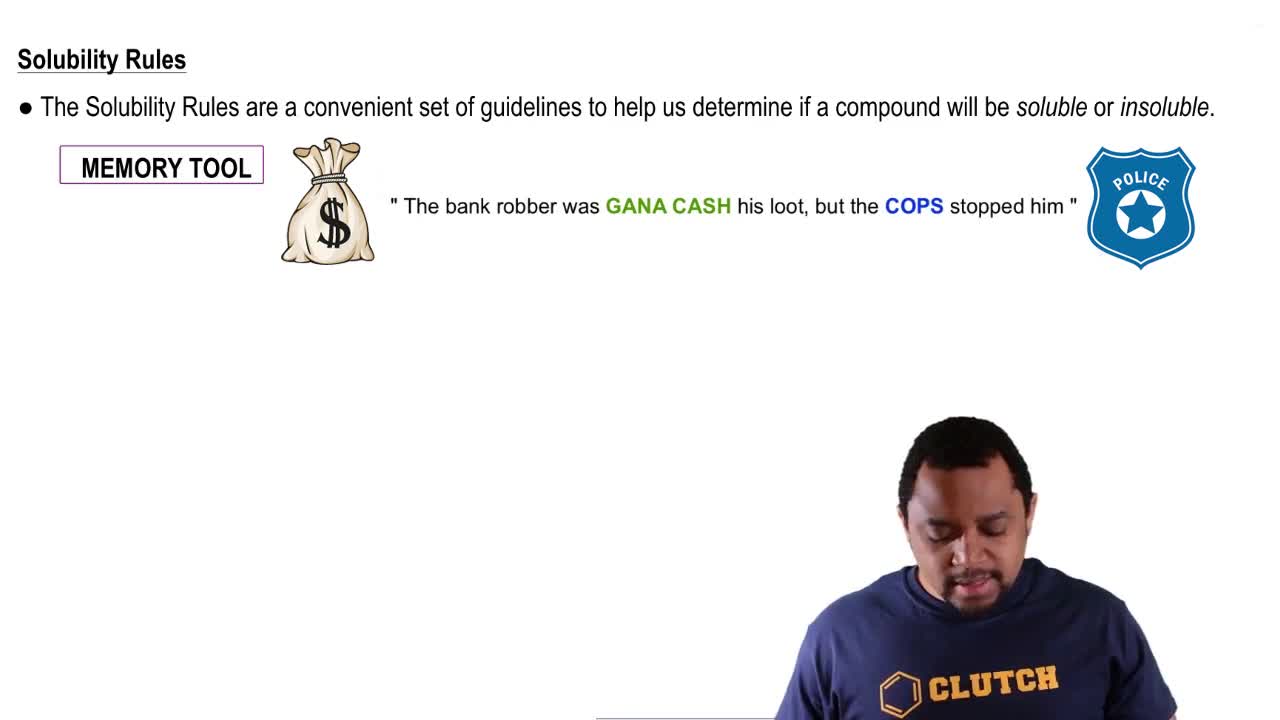
Solubility Rules

Solubility rules are guidelines that help predict the solubility of various ionic compounds in water. For example, most hydroxides are insoluble except for those of alkali metals and some alkaline earth metals. Knowing these rules is essential for determining whether a precipitate will form when mixing solutions, as it allows one to identify which products are soluble and which are not.
Video consigliato:
Percorso guidato
00:28
Solubility Rules

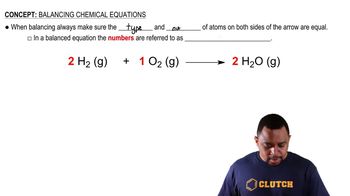
Balanced Chemical Equations

A balanced chemical equation represents a chemical reaction with equal numbers of each type of atom on both sides of the equation. Balancing is crucial for accurately depicting the conservation of mass during a reaction. In the context of precipitation reactions, writing a balanced equation involves identifying the reactants, the products formed (including any precipitate), and ensuring that the number of atoms for each element is the same on both sides.
Video consigliato:
Percorso guidato
01:32
Balancing Chemical Equations