
Ch.4 - Reactions in Aqueous Solution
Brown - Chemistry: The Central Science 14th Edition
Brown14th EditionChemistry: The Central ScienceISBN: 9780134414232Non è quello che usi tu?Cambia libro di testo
Capitolo 4, Problema 96a

The commercial production of nitric acid involves the following chemical reactions:
4 NH3(g) + 5 O2(g) → 4 NO(g) + 6 H2O(g)
2 NO(g) + O2(g) → 2 NO2(g)
3 NO2(g) + H2O(l) → 2 HNO3(aq) + NO(g)
(a) Which of these reactions are redox reactions?

Guida verificata passo dopo passo
1
Identify the oxidation states of each element in the reactants and products for each reaction.
For the first reaction: 4 NH_3(g) + 5 O_2(g) → 4 NO(g) + 6 H_2O(g), determine the change in oxidation states for nitrogen and oxygen.
For the second reaction: 2 NO(g) + O_2(g) → 2 NO_2(g), determine the change in oxidation states for nitrogen and oxygen.
For the third reaction: 3 NO_2(g) + H_2O(l) → 2 HNO_3(aq) + NO(g), determine the change in oxidation states for nitrogen.
Identify which reactions involve a change in oxidation states, indicating they are redox reactions.

Risposta video verificata per un problema simile:

Questa soluzione video è stata consigliata dai nostri tutor come utile per risolvere questo problema.
Durata del video:
1m

Concetti chiave

Ecco i concetti essenziali che devi comprendere per rispondere correttamente alla domanda.

Redox Reactions

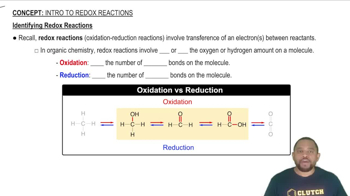
Redox reactions, or reduction-oxidation reactions, involve the transfer of electrons between substances. In these reactions, one species is oxidized (loses electrons) while another is reduced (gains electrons). Identifying redox reactions requires analyzing changes in oxidation states of the elements involved.
Video consigliato:
Percorso guidato
03:12
Identifying Redox Reactions

Oxidation States

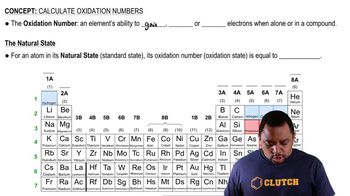
Oxidation states (or oxidation numbers) are assigned to atoms in a compound to indicate their degree of oxidation or reduction. The oxidation state helps in determining which atoms are oxidized and which are reduced in a reaction. For example, in the reaction of ammonia with oxygen, nitrogen in NH3 has an oxidation state of -3, which changes to +2 in NO.
Video consigliato:
Percorso guidato
02:42
Oxidation Numbers

Balancing Chemical Reactions

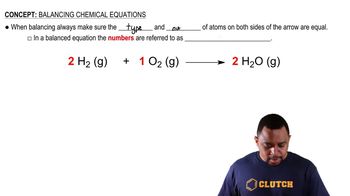
Balancing chemical reactions is essential to ensure that the number of atoms of each element is conserved throughout the reaction. This involves adjusting coefficients in front of the reactants and products. In redox reactions, balancing also includes ensuring that the total charge is the same on both sides of the equation, which is crucial for identifying the electron transfer.
Video consigliato:
Percorso guidato
01:32
Balancing Chemical Equations
Pratica correlata
Domanda del libro di testo

Antacids are often used to relieve pain and promote healing in the treatment of mild ulcers. Write balanced net ionic equations for the reactions between the aqueous HCl in the stomach and each of the following substances used in various antacids: (a) Al(OH)3(s) (b) Mg(OH)2(s) (c) MgCO3(s) (d) NaAl(CO3)(OH)2(s) (e) CaCO3(s).

400
views
Domanda del libro di testo

The commercial production of nitric acid involves the following chemical reactions:

4 NH3(g) + 5 O2(g) → 4 NO(g) + 6 H2O(g)

2 NO(g) + O2(g) → 2 NO2(g)

3 NO2(g) + H2O(l) → 2 HNO3(aq) + NO(g)

(c) How many grams of ammonia must you start with to make 1000.0 L of a 0.150 M aqueous solution of nitric acid? Assume all the reactions give 100% yield.

1255
views
Domanda del libro di testo

Consider the following reagents: zinc, copper, mercury (density 13.6 g/mL), silver nitrate solution, nitric acid solution. (a) Given a 500-mL Erlenmeyer flask and a balloon, can you combine two or more of the foregoing reagents to initiate a chemical reaction that will inflate the balloon? Write a balanced chemical equation to represent this process. What is the identity of the substance that inflates the balloon?

373
views
Domanda del libro di testo

The commercial production of nitric acid involves the following chemical reactions:

4 NH3(g) + 5 O2(g) → 4 NO(g) + 6 H2O(g)

2 NO(g) + O2(g) → 2 NO2(g)

3 NO2(g) + H2O(l) → 2 HNO3(aq) + NO(g)

(b) Identify the element undergoing oxidation and the element undergoing reduction.

365
views