Ch.4 - Reactions in Aqueous Solution
Brown - Chemistry: The Central Science 14th Edition
Brown14th EditionChemistry: The Central ScienceISBN: 9780134414232Non è quello che usi tu?Cambia libro di testo
Capitolo 4, Problema 56b,c

Using the activity series (Table 4.5), write balanced chemical equations for the following reactions. If no reaction occurs, write NR. (b) a solution of zinc nitrate is added to a solution of magnesium sulfate (c) hydrochloric acid is added to gold metal

Guida verificata passo dopo passo
1
Identify the reactants in the given solutions: zinc nitrate (Zn(NO_3)_2) and magnesium sulfate (MgSO_4).
Determine the possible products of the reaction: zinc sulfate (ZnSO_4) and magnesium nitrate (Mg(NO_3)_2).
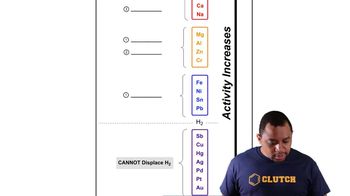
Use the activity series to compare the reactivity of zinc and magnesium. Zinc is less reactive than magnesium.
Since zinc is less reactive than magnesium, it cannot displace magnesium from magnesium sulfate. Therefore, no reaction occurs.
Write the final conclusion: NR (No Reaction).

Risposta video verificata per un problema simile:

Questa soluzione video è stata consigliata dai nostri tutor come utile per risolvere questo problema.
Durata del video:
2m

Concetti chiave

Ecco i concetti essenziali che devi comprendere per rispondere correttamente alla domanda.

Activity Series

The activity series is a list of metals ranked by their ability to displace other metals from compounds in solution. Metals higher in the series can displace those lower from their compounds, which is crucial for predicting whether a reaction will occur when two metal solutions are mixed.
Video consigliato:
Percorso guidato
02:02
Activity Series Chart

Double Displacement Reaction

A double displacement reaction occurs when two compounds exchange ions to form two new compounds. This type of reaction is common in aqueous solutions and can be represented by the general formula AB + CD → AD + CB, where A and C are cations and B and D are anions.
Video consigliato:
Percorso guidato
01:11
Single Displacement Reactions

Solubility Rules

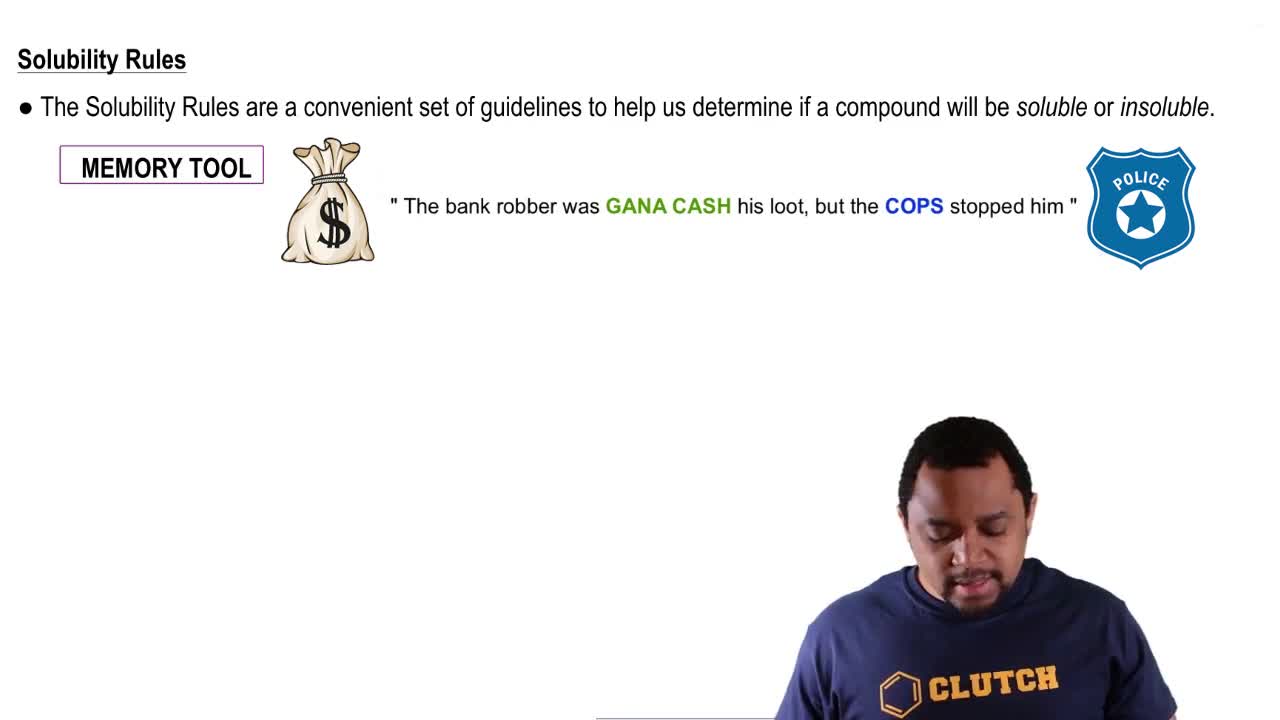
Solubility rules help predict whether a compound will dissolve in water. For example, most nitrates are soluble, while many sulfates are not. Understanding these rules is essential for determining if a precipitate will form during a reaction, which influences the overall reaction outcome.
Video consigliato:
Percorso guidato
00:28
Solubility Rules
Pratica correlata
Domanda del libro di testo

Using the activity series (Table 4.5), write balanced chemical equations for the following reactions. If no reaction occurs, write NR. (e) aluminum metal is added to a solution of cobalt(II) sulfate.

422
views

Domanda del libro di testo

Using the activity series (Table 4.5), write balanced chemical equations for the following reactions. If no reaction occurs, write NR. (d) chromium metal is immersed in an aqueous solution of cobalt(II) chloride

735
views
Domanda del libro di testo

Using the activity series (Table 4.5), write balanced chemical equations for the following reactions. If no reaction occurs, write NR. (a) Nickel metal is added to a solution of copper(II) nitrate

744
views
Domanda del libro di testo

The metal cadmium tends to form Cd2+ ions. The following observations are made: (i) When a strip of zinc metal is placed in CdCl2(aq), cadmium metal is deposited on the strip. (ii) When a strip of cadmium metal is placed in Ni(NO3)(aq), nickel metal is deposited on the strip. (a) Write net ionic equations to explain each of the preceding observations.

1
views
Domanda del libro di testo

Using the activity series (Table 4.5), write balanced chemical equations for the following reactions. If no reaction occurs, write NR. (e) hydrogen gas is bubbled through a solution of silver nitrate.

583
views
Domanda del libro di testo

Using the activity series (Table 4.5), write balanced chemical equations for the following reactions. If no reaction occurs, write NR. (d) hydrogen gas is bubbled through an aqueous solution of nickel(II) chloride

758
views