

State whether each of the following statements is true or false. Justify your answer in each case. (b) If you add a nonelectrolyte to an aqueous solution that already contains an electrolyte, the electrical conductivity will not change.
Ch.4 - Reactions in Aqueous Solution
Brown14th EditionChemistry: The Central ScienceISBN: 9780134414232Non è quello che usi tu?Cambia libro di testo
Capitolo 4, Problema 12
You are titrating an acidic solution with a basic one, and just realized you forgot to add the indicator that tells you when the equivalence point is reached. In this titration, the indicator turns blue at the equivalence point from an initially colorless solution. You quickly grab a bottle of indicator and add some to your titration beaker, and the whole solution turns dark blue. What do you do now?
Guida verificata passo dopo passo1
1. The dark blue color indicates that the solution has passed the equivalence point. This is because the indicator changes color when the solution changes from acidic to basic, which happens at the equivalence point. If the solution is dark blue, it means it is now basic.
2. The titration has gone too far, and you've added more base than needed to neutralize the acid. Therefore, you cannot accurately determine the concentration of the acid in the solution at this point.
3. To correct this, you will need to start the titration process over again. Dispose of the current solution safely according to your lab's guidelines.
4. Prepare a new sample of the acidic solution, ensuring it is the same volume and concentration as the original sample.
5. Before starting the titration, remember to add the indicator to the new solution. Then, proceed with the titration, adding the base slowly and carefully to avoid overshooting the equivalence point again.

Risposta video verificata per un problema simile:
Questa soluzione video è stata consigliata dai nostri tutor come utile per risolvere questo problema.
Durata del video:
1mConcetti chiave
Ecco i concetti essenziali che devi comprendere per rispondere correttamente alla domanda.
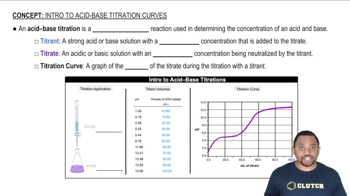
Titration
Titration is a quantitative analytical technique used to determine the concentration of an unknown solution by reacting it with a solution of known concentration. In an acid-base titration, an acid reacts with a base, and the endpoint is indicated by a color change, often facilitated by an indicator. Understanding the titration process is crucial for interpreting results and determining the equivalence point.
Video consigliato:
Percorso guidato
Acid-Base Titration
Equivalence Point
The equivalence point in a titration is the stage at which the amount of titrant added is stoichiometrically equivalent to the amount of substance in the solution being titrated. This point is significant because it indicates that the reaction between the acid and base is complete. Identifying the equivalence point is essential for accurate calculations of concentration.
Video consigliato:
Percorso guidato
At the Equivalence Point
Indicators
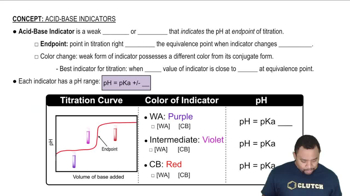
Indicators are substances that change color at a specific pH range, signaling the completion of a reaction in titrations. In this scenario, the indicator turns blue at the equivalence point, providing a visual cue for the titration's progress. Choosing the appropriate indicator is vital, as it must change color at or near the pH of the equivalence point for accurate results.
Video consigliato:
Percorso guidato
Acid-Base Indicators
Pratica correlata
Domanda del libro di testo
987
views
Domanda del libro di testo
An aqueous solution contains 1.2 mM of total ions. (a) If the solution is NaCl(aq), what is the concentration of chloride ion?
1143
views
Domanda del libro di testo
Which data set, of the two graphed here, would you expect to observe from a titration like that shown in Figure 4.18?
286
views
Domanda del libro di testo
(a) Do colloids made only of gases exist? Why or why not?
124
views
Domanda del libro di testo
State whether each of the following statements is true or false. Justify your answer in each case. (a) Electrolyte solutions conduct electricity because electrons are moving through the solution.
517
views
Domanda del libro di testo
An aqueous solution contains 1.2 mM of total ions. (b) If the solution is FeCl3(aq), what is the concentration of chloride ion?
532
views
