
Ch.5 - Thermochemistry
Brown - Chemistry: The Central Science 14th Edition
Brown14th EditionChemistry: The Central ScienceISBN: 9780134414232Non è quello che usi tu?Cambia libro di testo
Capitolo 5, Problema 106b

A coffee-cup calorimeter of the type shown in Figure 5.18 contains 150.0 g of water at 25.1°C A 121.0-g block of copper metal is heated to 100.4°C by putting it in a beaker of boiling water. The specific heat of Cu(s) is 0.385 J/g-K The Cu is added to the calorimeter, and after a time the contents of the cup reach a constant temperature of 30.1°C (b) Determine the amount of heat gained by the water. The specific heat of water is 4.184 J/1gK.

Guida verificata passo dopo passo
1
Identify the known values: mass of water (m_w) = 150.0 g, initial temperature of water (T_i,w) = 25.1°C, final temperature of water (T_f) = 30.1°C, specific heat of water (c_w) = 4.184 J/g-K.
Calculate the change in temperature for the water: ΔT_w = T_f - T_i,w.
Use the formula for heat gained or lost: q = m * c * ΔT, where q is the heat gained or lost, m is the mass, c is the specific heat, and ΔT is the change in temperature.
Substitute the known values into the formula: q_w = m_w * c_w * ΔT_w.
Solve for q_w to find the amount of heat gained by the water.

Risposta video verificata per un problema simile:

Questa soluzione video è stata consigliata dai nostri tutor come utile per risolvere questo problema.
Durata del video:
1m

Concetti chiave

Ecco i concetti essenziali che devi comprendere per rispondere correttamente alla domanda.

Specific Heat Capacity

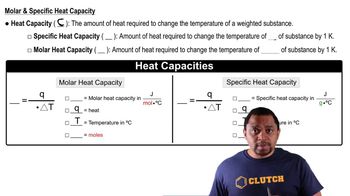
Specific heat capacity is the amount of heat required to raise the temperature of one gram of a substance by one degree Celsius (or one Kelvin). It is a material-specific property that varies between different substances. For example, water has a high specific heat capacity of 4.184 J/g-K, meaning it can absorb a lot of heat without a significant change in temperature, which is crucial in calorimetry calculations.
Video consigliato:

Calorimetry

Calorimetry is the science of measuring the heat of chemical reactions or physical changes. In a calorimeter, the heat lost by a hot object (like the copper block) is equal to the heat gained by the cooler substance (like water). This principle allows us to calculate the heat transfer in a system, which is essential for solving problems involving temperature changes and specific heat.
Video consigliato:
Percorso guidato
00:50
Constant-Volume Calorimetry

Heat Transfer Equation

The heat transfer equation, often expressed as q = mcΔT, relates the heat gained or lost (q) to the mass (m), specific heat capacity (c), and the change in temperature (ΔT) of a substance. In this context, it allows us to calculate the amount of heat gained by the water when the copper block is added, by substituting the known values of mass, specific heat, and temperature change into the equation.
Video consigliato:
Pratica correlata
Domanda del libro di testo

A house is designed to have passive solar energy features. Brickwork incorporated into the interior of the house acts as a heat absorber. Each brick weighs approximately 1.8 kg. The specific heat of the brick is 0.85 J/g•K. How many bricks must be incorporated into the interior of the house to provide the same total heat capacity as 1.7⨉103 gal of water?

1818
views
Domanda del libro di testo

(b) Assuming that there is an uncertainty of 0.002 °C in each temperature reading and that the masses of samples are measured to 0.001 g, what is the estimated uncertainty in the value calculated for the heat of combustion per mole of caffeine?

912
views
1
rank
Domanda del libro di testo

A coffee-cup calorimeter of the type shown in Figure 5.18 contains 150.0 g of water at 25.1°C A 121.0-g block of copper metal is heated to 100.4°C by putting it in a beaker of boiling water. The specific heat of Cu(s) is 0.385 J/g-K The Cu is added to the calorimeter, and after a time the contents of the cup reach a constant temperature of 30.1°C (d) What would be the final temperature of the system if all the heat lost by the copper block were absorbed by the water in the calorimeter?

1200
views
1
comments
Domanda del libro di testo

A coffee-cup calorimeter of the type shown in Figure 5.18 contains 150.0 g of water at 25.1°C A 121.0-g block of copper metal is heated to 100.4°C by putting it in a beaker of boiling water. The specific heat of Cu(s) is 0.385 J/g-K The Cu is added to the calorimeter, and after a time the contents of the cup reach a constant temperature of 30.1°C. (a) Determine the amount of heat, in J, lost by the copper block.

809
views