Ch.5 - Thermochemistry
Brown - Chemistry: The Central Science 14th Edition
Brown14th EditionChemistry: The Central ScienceISBN: 9780134414232Non è quello che usi tu?Cambia libro di testo
Capitolo 5, Problema 97

At the end of 2012, global population was about 7.0 billion people. What mass of glucose in kg would be needed to provide 1500 Cal/person/day of nourishment to the global population for one year? Assume that glucose is metabolized entirely to CO2(𝑔) and H2O(𝑙) according to the following thermochemical equation: C6H12O6(s) + 6 O2(𝑔) → 6 CO2(𝑔) + 6 H2O(𝑙) ΔH° = -2803 kJ

Guida verificata passo dopo passo
1
Calculate the total number of Calories needed for the global population for one year. Multiply the daily Caloric intake per person by the number of people and then by the number of days in a year.
Convert the total Caloric intake from Calories to kilojoules (kJ) knowing that 1 Calorie equals 4.184 kJ.
Use the thermochemical equation provided to determine the amount of energy produced by the combustion of glucose. Note that the combustion of one mole of glucose releases 2803 kJ.
Calculate the number of moles of glucose needed to meet the global energy requirement by dividing the total energy requirement (from step 2) by the energy released per mole of glucose (from step 3).
Convert the number of moles of glucose to mass in kilograms. Use the molar mass of glucose, which is approximately 180.16 g/mol, and convert grams to kilograms.

Risposta video verificata per un problema simile:

Questa soluzione video è stata consigliata dai nostri tutor come utile per risolvere questo problema.
Durata del video:
4m

Concetti chiave

Ecco i concetti essenziali che devi comprendere per rispondere correttamente alla domanda.

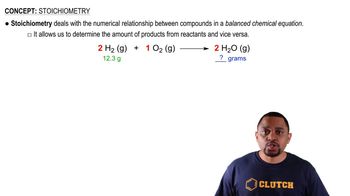
Stoichiometry

Stoichiometry is the calculation of reactants and products in chemical reactions based on the balanced chemical equation. It allows us to determine the amount of a substance needed or produced in a reaction. In this question, stoichiometry will help calculate how much glucose is required to meet the caloric needs of the global population by using the provided thermochemical equation.
Video consigliato:
Percorso guidato
01:16
Stoichiometry Concept

Caloric Conversion

Caloric conversion involves translating energy requirements, typically measured in calories, into a mass of a specific substance. In this case, we need to convert the daily caloric needs of the population into a total annual requirement and then relate that to the energy released from glucose metabolism. Understanding this conversion is essential for determining the mass of glucose needed.
Video consigliato:
Percorso guidato
01:56
Conversion Factors

Thermochemistry

Thermochemistry is the study of the heat energy associated with chemical reactions. The given thermochemical equation provides the enthalpy change (ΔH°) for the metabolism of glucose, indicating how much energy is released when glucose is completely oxidized. This information is crucial for calculating how much glucose is necessary to provide the required energy for the global population.
Video consigliato:
Pratica correlata
Domanda del libro di testo

The standard enthalpies of formation of gaseous propyne (C3H4), propylene (C3H6), and propane (C3H8) are +185.4, +20.4, and -103.8 kJ/mol, respectively. (c) Which is the most efficient fuel in terms of heat evolved per unit mass?

1938
views
Domanda del libro di testo

It is interesting to compare the 'fuel value' of a hydrocarbon in a hypothetical world where oxygen is not the combustion agent. The enthalpy of formation of CF4(g) is -679.9 kJ/mol. Which of the following two reactions is the more exothermic?

CH4(g) + 2 O2(g) → CO2(g) + 2 H2O(g)

CH4(g) + 4 F2(g) → CF4(g) + 4 HF(g)

854
views
Domanda del libro di testo

The air bags that provide protection in automobiles in the event of an accident expand because of a rapid chemical reaction. From the viewpoint of the chemical reactants as the system, what do you expect for the signs of q and w in this process?

885
views
Domanda del libro di testo

The automobile fuel called E85 consists of 85% ethanol and 15% gasoline. E85 can be used in the so-called flex-fuel vehicles (FFVs), which can use gasoline, ethanol, or a mix as fuels. Assume that gasoline consists of a mixture of octanes (different isomers of C8H18), that the average heat of combustion of C8H18(l) is 5400 kJ/mol, and that gasoline has an average density of 0.70 g/mL. The density of ethanol is 0.79 g/mL. (a) By using the information given as well as data in Appendix C, compare the energy produced by combustion of 1.0 L of gasoline and of 1.0 L of ethanol.

1969
views
Domanda del libro di testo

The standard enthalpies of formation of gaseous propyne (C3H4), propylene (C3H6), and propane (C3H8) are +185.4, +20.4, and -103.8 kJ/mol, respectively. (a) Calculate the heat evolved per mole on combustion of each substance to yield CO2(g) and H2O(g). (b) Calculate the heat evolved on combustion of 1 kg of each substance.

599
views