Ch.5 - Thermochemistry
Brown - Chemistry: The Central Science 14th Edition
Brown14th EditionChemistry: The Central ScienceISBN: 9780134414232Non è quello che usi tu?Cambia libro di testo
Capitolo 5, Problema 49b

(b) The specific heat of aluminum is 0.9 J/(g - K). Calculate its molar heat capacity.

Guida verificata passo dopo passo
1
Determine the molar mass of aluminum, which is approximately 26.98 g/mol.
Understand that the specific heat capacity (c) is given in J/(g\(\cdot\) K), which means it is the energy required to raise the temperature of 1 gram of the substance by 1 Kelvin.
Recognize that molar heat capacity (C) is the energy required to raise the temperature of one mole of a substance by 1 Kelvin.
Use the formula for molar heat capacity: C = c \(\times\) molar mass. Here, c is the specific heat capacity and the molar mass is the mass of one mole of the substance.
Substitute the values into the formula: C = 0.9 \, \(\text{J/(g\cdot K)}\) \(\times\) 26.98 \, \(\text{g/mol}\).

Risposta video verificata per un problema simile:

Questa soluzione video è stata consigliata dai nostri tutor come utile per risolvere questo problema.
Durata del video:
53s

Concetti chiave

Ecco i concetti essenziali che devi comprendere per rispondere correttamente alla domanda.

Specific Heat Capacity

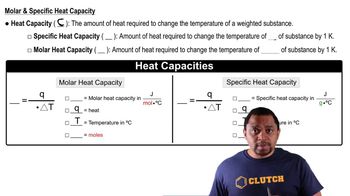
Specific heat capacity is the amount of heat required to raise the temperature of one gram of a substance by one degree Celsius (or one Kelvin). It is a material-specific property that indicates how much energy a substance can store per unit mass. In this case, aluminum has a specific heat of 0.9 J/(g·K), meaning it requires 0.9 joules of energy to increase the temperature of one gram of aluminum by one Kelvin.
Video consigliato:

Molar Heat Capacity

Molar heat capacity is the amount of heat required to raise the temperature of one mole of a substance by one degree Celsius (or one Kelvin). It is calculated by multiplying the specific heat capacity by the molar mass of the substance. For aluminum, to find its molar heat capacity, we need to use its specific heat and the molar mass, which is approximately 27 g/mol.
Video consigliato:

Conversion from Specific Heat to Molar Heat Capacity

To convert specific heat capacity to molar heat capacity, the formula used is: Molar Heat Capacity = Specific Heat Capacity × Molar Mass. This relationship allows us to express the heat capacity in terms of moles rather than grams, which is particularly useful in chemical reactions and thermodynamic calculations. For aluminum, this conversion will yield the molar heat capacity in J/(mol·K).
Video consigliato:
Pratica correlata
Domanda del libro di testo

(a) What amount of heat (in joules) is required to raise the temperature of 1 g of water by 1 kelvin? (b) What amount of heat (in joules) is required to raise the temperature of 1 mole of water by 1 kelvin?

Domanda del libro di testo

Two solid objects, A and B, are placed in boiling water and allowed to come to the temperature of the water. Each is then lifted out and placed in separate beakers containing 1000 g of water at 10.0 °C. Object A increases the water temperature by 3.50 °C; B increases the water temperature by 2.60 °C. (b) What can you say about the specific heats of A and B?

Domanda del libro di testo

Consider the decomposition of liquid benzene, C6H6(l), to gaseous acetylene, C2H2(g): C6H6(l) → 3 C2H2(g) ΔH = +630 kJ (c) Which is more likely to be thermodynamically favored, the forward reaction or the reverse reaction?

344
views
Domanda del libro di testo

Two solid objects, A and B, are placed in boiling water and allowed to come to the temperature of the water. Each is then lifted out and placed in separate beakers containing 1000 g of water at 10.0 °C. Object A increases the water temperature by 3.50 °C; B increases the water temperature by 2.60 °C. (a) Which object has the larger heat capacity?

1585
views
1
rank
Domanda del libro di testo

Consider the decomposition of liquid benzene, C6H6(l), to gaseous acetylene, C2H2(g): C6H6(l) → 3 C2H2(g) ΔH = +630 kJ (d) If C6H6(g) were consumed instead of C6H6(l), would you expect the magnitude of ΔH to increase, decrease, or stay the same? Explain.

682
views