
Ch.5 - Thermochemistry
Brown - Chemistry: The Central Science 14th Edition
Brown14th EditionChemistry: The Central ScienceISBN: 9780134414232Non è quello che usi tu?Cambia libro di testo
Capitolo 5, Problema 47a

Consider the combustion of liquid methanol, CH3OH(l): CH3OH(l) + 3/2 O2(g) → CO2(g) + 2 H2O(l) ΔH = -726.5 kJ (a) What is the enthalpy change for the reverse reaction?

Guida verificata passo dopo passo
1
Identify the given reaction: CH_3OH(l) + \(\frac{3}{2}\) O_2(g) \(\rightarrow\) CO_2(g) + 2 H_2O(l) with \(\Delta\) H = -726.5 \(\text{ kJ}\).
Understand that the reverse reaction is: CO_2(g) + 2 H_2O(l) \(\rightarrow\) CH_3OH(l) + \(\frac{3}{2}\) O_2(g).
Recall that the enthalpy change for a reverse reaction is the negative of the enthalpy change for the forward reaction.
Apply this concept: \(\Delta\) H_{reverse} = - (\(\Delta\) H_{forward}).
Substitute the given \(\Delta\) H_{forward} value into the equation to find \(\Delta\) H_{reverse}.

Risposta video verificata per un problema simile:

Questa soluzione video è stata consigliata dai nostri tutor come utile per risolvere questo problema.
Durata del video:
1m

Concetti chiave

Ecco i concetti essenziali che devi comprendere per rispondere correttamente alla domanda.

Enthalpy Change

Enthalpy change (ΔH) is a measure of the heat content of a system at constant pressure. It indicates the amount of energy absorbed or released during a chemical reaction. A negative ΔH value, like -726.5 kJ in the combustion of methanol, signifies that the reaction is exothermic, releasing energy to the surroundings.
Video consigliato:
Percorso guidato
02:34
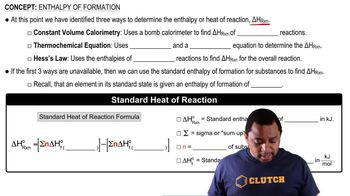
Enthalpy of Formation

Reverse Reaction

The reverse reaction is the process in which the products of a chemical reaction are converted back into the original reactants. For the combustion of methanol, the reverse reaction would involve converting carbon dioxide and water back into methanol and oxygen. The enthalpy change for the reverse reaction is equal in magnitude but opposite in sign to that of the forward reaction.
Video consigliato:
Percorso guidato
03:42
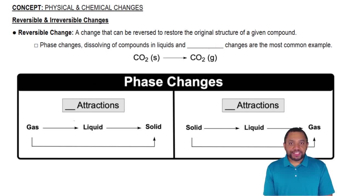
Reversible Changes in Matter

Thermodynamic Principles

Thermodynamic principles govern the relationships between heat, work, and energy in chemical reactions. According to the first law of thermodynamics, energy cannot be created or destroyed, only transformed. This principle helps in understanding that the enthalpy change for a reaction and its reverse are related, allowing us to calculate the enthalpy change for the reverse reaction directly from the forward reaction's ΔH.
Video consigliato:
Percorso guidato
01:18
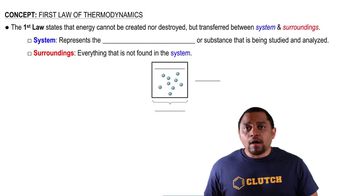
First Law of Thermodynamics
Pratica correlata
Domanda del libro di testo

At one time, a common means of forming small quantities of oxygen gas in the laboratory was to heat KClO3: 2 KClO3(s) → 2 KCl(s) + 3 O2(g) ΔH = -89.4 kJ (c) The decomposition of KClO3 proceeds spontaneously when it is heated. Do you think that the reverse reaction, the formation of KClO3 from KCl and O2, is likely to be feasible under ordinary conditions? Explain your answer.

559
views
Domanda del libro di testo

Consider the combustion of liquid methanol, CH3OH(l): CH3OH(l) + 3/2 O2(g) → CO2(g) + 2 H2O(l) ΔH = -726.5 kJ (b) Balance the forward reaction with whole-number coefficients. What is ΔH for the reaction represented by this equation?

706
views
Domanda del libro di testo

At one time, a common means of forming small quantities of oxygen gas in the laboratory was to heat KClO3: 2 KClO3(s) → 2 KCl(s) + 3 O2(g) ΔH = -89.4 kJ For this reaction, calculate H for the formation of (a) 1.36 mol of O2

560
views
Domanda del libro di testo

At one time, a common means of forming small quantities of oxygen gas in the laboratory was to heat KClO3: 2 KClO3(s) → 2 KCl(s) + 3 O2(g) ΔH = -89.4 kJ For this reaction, calculate H for the formation of (b) 10.4 g of KCl.

423
views
Domanda del libro di testo

Consider the decomposition of liquid benzene, C6H6(l), to gaseous acetylene, C2H2(g): C6H6(l) → 3 C2H2(g) ΔH = +630 kJ (a) What is the enthalpy change for the reverse reaction?

803
views
Domanda del libro di testo

Consider the combustion of liquid methanol, CH3OH(l): CH3OH(l) + 3/2 O2(g) → CO2(g) + 2 H2O(l) ΔH = -726.5 kJ (d) If the reaction were written to produce H2O(g) instead of H2O(l), would you expect the magnitude of ΔH to increase, decrease, or stay the same? Explain.

1
views