
Ch.5 - Thermochemistry
Brown - Chemistry: The Central Science 14th Edition
Brown14th EditionChemistry: The Central ScienceISBN: 9780134414232Non è quello che usi tu?Cambia libro di testo
Capitolo 5, Problema 54c

Consider the data about gold metal in Exercise 5.26(b). (c) What is the molar heat capacity of Au(s)?

Guida verificata passo dopo passo
1
Identify the specific heat capacity of gold (Au) from the data provided in Exercise 5.26(b).
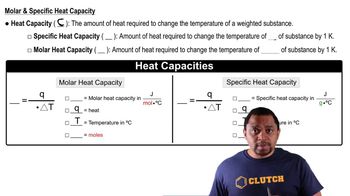
Recall the formula for molar heat capacity, which is given by: \( C_m = C_s \times M \), where \( C_s \) is the specific heat capacity and \( M \) is the molar mass.
Look up the molar mass of gold (Au), which is typically found on the periodic table.
Substitute the values of \( C_s \) and \( M \) into the formula to calculate the molar heat capacity of gold.
Ensure the units are consistent and convert if necessary, typically the molar heat capacity is expressed in units of J/(mol\(\cdot\) K).

Risposta video verificata per un problema simile:

Questa soluzione video è stata consigliata dai nostri tutor come utile per risolvere questo problema.
Durata del video:
2m

Concetti chiave

Ecco i concetti essenziali che devi comprendere per rispondere correttamente alla domanda.

Molar Heat Capacity

Molar heat capacity is the amount of heat required to raise the temperature of one mole of a substance by one degree Celsius (or one Kelvin). It is an important property that reflects how a substance absorbs and retains heat, influencing its thermal behavior. For solids, this value can vary based on the material's structure and bonding.
Video consigliato:

Specific Heat Capacity

Specific heat capacity is the heat required to raise the temperature of one gram of a substance by one degree Celsius. While molar heat capacity is expressed per mole, specific heat is often used for practical calculations in chemistry. The relationship between the two can be established by multiplying the specific heat capacity by the molar mass of the substance.
Video consigliato:

Thermodynamic Properties of Metals

The thermodynamic properties of metals, including heat capacity, are influenced by their atomic structure and bonding. Metals typically have high thermal conductivity and specific heat capacities, which affect how they respond to heat. Understanding these properties is essential for predicting how metals behave under varying temperature conditions, such as in reactions or phase changes.
Video consigliato:
Percorso guidato
02:05
Metal Properties