Ch.5 - Thermochemistry
Brown - Chemistry: The Central Science 14th Edition
Brown14th EditionChemistry: The Central ScienceISBN: 9780134414232Non è quello che usi tu?Cambia libro di testo
Capitolo 5, Problema 87

Consider the reaction 2 H2(g) + O2(g) → 2 H2O(l). (b) Without doing a calculation, predict whether your estimate in part (a) is more negative or less negative than the true reaction enthalpy.

Guida verificata passo dopo passo
1
Understand that the reaction given is the formation of water from hydrogen and oxygen gases. This is an exothermic reaction, meaning it releases heat.
Recall that the enthalpy change for a reaction ( ΔH ) is negative for exothermic reactions because energy is released.
Consider the bond energies involved: breaking bonds in reactants (H-H and O=O) requires energy, while forming bonds in products (O-H in water) releases energy.
Recognize that the bond formation in water releases more energy than the energy required to break the bonds in hydrogen and oxygen, leading to a net release of energy.
Conclude that if your estimate in part (a) was based on average bond energies, it might be less negative than the true reaction enthalpy because specific bond energies in the actual reaction could lead to a greater release of energy.

Concetti chiave

Ecco i concetti essenziali che devi comprendere per rispondere correttamente alla domanda.

Enthalpy of Reaction

The enthalpy of reaction, or reaction enthalpy, is the heat change associated with a chemical reaction at constant pressure. It indicates whether a reaction is exothermic (releases heat, negative enthalpy change) or endothermic (absorbs heat, positive enthalpy change). Understanding this concept is crucial for predicting the energy changes that occur during the formation of products from reactants.
Video consigliato:
Percorso guidato
02:34
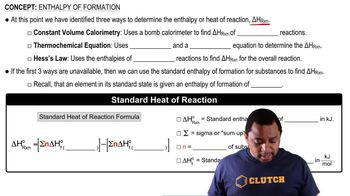
Enthalpy of Formation

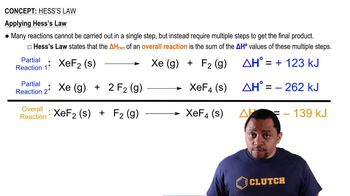
Hess's Law

Hess's Law states that the total enthalpy change for a reaction is the same, regardless of the number of steps taken to achieve the reaction. This principle allows chemists to calculate the enthalpy change of a reaction by summing the enthalpy changes of individual steps, making it essential for estimating reaction enthalpies without direct measurements.
Video consigliato:

Bond Enthalpies

Bond enthalpy refers to the amount of energy required to break a bond between two atoms in a molecule. It is a key factor in determining the overall enthalpy change of a reaction, as breaking bonds requires energy (endothermic) and forming bonds releases energy (exothermic). Understanding bond enthalpies helps in estimating whether the overall reaction enthalpy will be more or less negative than an initial estimate.
Video consigliato:
Percorso guidato
02:34
Enthalpy of Formation