
Consider two solutions, the first being 50.0 mL of 1.00 M CuSO4 and the second 50.0 mL of 2.00 M KOH. When the two solutions are mixed in a constant-pressure calorimeter, a precipitate forms and the temperature of the mixture rises from 21.5 to 27.7 °C (d) From the calorimetric data, calculate ΔH for the reaction that occurs on mixing. Assume that the calorimeter absorbs only a negligible quantity of heat, that the total volume of the solution is 100.0 mL, and that the specific heat and density of the solution after mixing are the same as those of pure water.
Ch.5 - Thermochemistry
Brown14th EditionChemistry: The Central ScienceISBN: 9780134414232Non è quello che usi tu?Cambia libro di testo
Capitolo 5, Problema 123a
Consider two solutions, the first being 50.0 mL of 1.00 M CuSO4 and the second 50.0 mL of 2.00 M KOH. When the two solutions are mixed in a constant-pressure calorimeter, a precipitate forms and the temperature of the mixture rises from 21.5 to 27.7 °C. (a) Before mixing, how many grams of Cu are present in the solution of CuSO4?
Guida verificata passo dopo passo1
Determine the molarity of the CuSO_4 solution, which is given as 1.00 M.
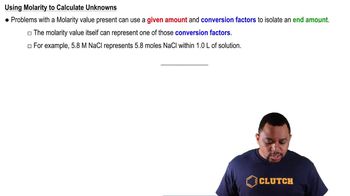
Calculate the number of moles of CuSO_4 in the solution using the formula: \( \text{moles} = \text{molarity} \times \text{volume in liters} \).
Convert the volume from mL to L: 50.0 mL = 0.0500 L.
Calculate the moles of CuSO_4: \( 1.00 \text{ M} \times 0.0500 \text{ L} = 0.0500 \text{ moles of CuSO_4} \).
Determine the mass of Cu in the solution by using the molar mass of Cu (63.55 g/mol) and the stoichiometry of the reaction, knowing that 1 mole of CuSO_4 contains 1 mole of Cu.

Risposta video verificata per un problema simile:
Questa soluzione video è stata consigliata dai nostri tutor come utile per risolvere questo problema.
Durata del video:
1mConcetti chiave
Ecco i concetti essenziali che devi comprendere per rispondere correttamente alla domanda.
Molarity and Moles
Molarity (M) is a measure of concentration defined as the number of moles of solute per liter of solution. To find the number of moles in a solution, you can multiply the molarity by the volume in liters. In this case, knowing the molarity of CuSO4 allows us to calculate the moles of copper present in the solution before mixing.
Video consigliato:
Percorso guidato
Molarity
Stoichiometry
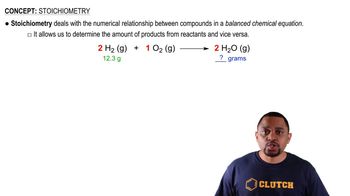
Stoichiometry involves the calculation of reactants and products in chemical reactions. In the context of this question, understanding the stoichiometric relationships in the dissociation of CuSO4 is essential to determine how many moles of copper ions (Cu²⁺) are produced from the given moles of CuSO4, which directly relates to the mass of copper present.
Video consigliato:
Percorso guidato
Stoichiometry Concept
Precipitation Reactions
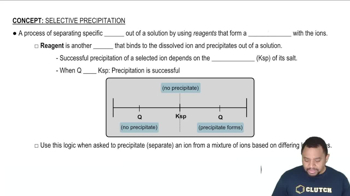
A precipitation reaction occurs when two solutions are mixed, resulting in the formation of an insoluble solid, or precipitate. In this scenario, the mixing of CuSO4 and KOH leads to the formation of copper(II) hydroxide (Cu(OH)₂), which is a precipitate. Understanding this concept helps in recognizing the significance of the reactants and products involved in the reaction.
Video consigliato:
Percorso guidato
Selective Precipitation
Pratica correlata
Domanda del libro di testo
1
views
Domanda del libro di testo
Consider the following unbalanced oxidation-reduction reactions in aqueous solution:
Ag+(aq) + Li(s) → Ag(s) + Li+(aq)
Fe(s) + Na+(aq) → Fe2+(aq) + Na(s)
K(s) + H2O(l) → KOH(aq) + H2(g)
(d) Use the activity series to predict which of these reactions should occur. (Section 4.4) Are these results in accord with your conclusion in part (c) of this problem?
Domanda del libro di testo
Consider the following acid-neutralization reactions involving
the strong base NaOH(aq):
HNO31aq2 + NaOH1aq2¡NaNO31aq2 + H2O1l2
HCl1aq2 + NaOH1aq2¡NaCl1aq2 + H2O1l2
NH4+1aq2 + NaOH1aq2¡NH31aq2 + Na+1aq2 + H2O1l2
(d) In the third equation NH4
+1aq2 is acting as an acid. Based
on the value of H° for this reaction, do you think it is a
strong or a weak acid? Explain.
739
views
Domanda del libro di testo
A sample of a hydrocarbon is combusted completely in
O21g2 to produce 21.83 g CO21g2, 4.47 g H2O1g2, and 311 kJ of
heat. (a) What is the mass of the hydrocarbon sample that
was combusted?
718
views
Domanda del libro di testo
Consider the following unbalanced oxidation-reduction reactions in aqueous solution:
Ag+(aq) + Li(s) → Ag(s) + Li+(aq)
Fe(s) + Na+(aq) → Fe2+(aq) + Na(s)
K(s) + H2O(l) → KOH(aq) + H2(g)
(a) Balance second reaction.
681
views
