Ch.5 - Thermochemistry
Brown - Chemistry: The Central Science 14th Edition
Brown14th EditionChemistry: The Central ScienceISBN: 9780134414232Non è quello che usi tu?Cambia libro di testo
Capitolo 5, Problema 80d

Methanol (CH3OH) is used as a fuel in race cars. (d) Calculate the mass of CO2 produced per kJ of heat emitted.

Guida verificata passo dopo passo
1
Write the balanced chemical equation for the combustion of methanol (CH3OH). The equation is CH3OH + 1.5 O2 → CO2 + 2 H2O.
Determine the molar mass of methanol (CH3OH) and carbon dioxide (CO2).
Calculate the amount of heat released per mole of methanol combusted. This information can be found in thermodynamic tables or can be calculated from enthalpy changes.
Using stoichiometry, calculate the mass of CO2 produced per mole of methanol combusted. This involves using the molar ratio from the balanced equation and the molar masses calculated in step 2.
Finally, calculate the mass of CO2 produced per kJ of heat emitted by dividing the mass of CO2 produced per mole of methanol by the heat released per mole of methanol, then multiplying by 1000 to convert from MJ to kJ.

Risposta video verificata per un problema simile:

Questa soluzione video è stata consigliata dai nostri tutor come utile per risolvere questo problema.
Durata del video:
3m

Concetti chiave

Ecco i concetti essenziali che devi comprendere per rispondere correttamente alla domanda.

Combustion Reaction

A combustion reaction is a chemical process in which a substance (usually a hydrocarbon) reacts with oxygen to produce carbon dioxide and water, releasing energy in the form of heat. In the case of methanol (CH3OH), its combustion can be represented by the balanced equation: 2 CH3OH + 3 O2 → 2 CO2 + 4 H2O. Understanding this reaction is essential for calculating the amount of CO2 produced.
Video consigliato:
Percorso guidato
02:24
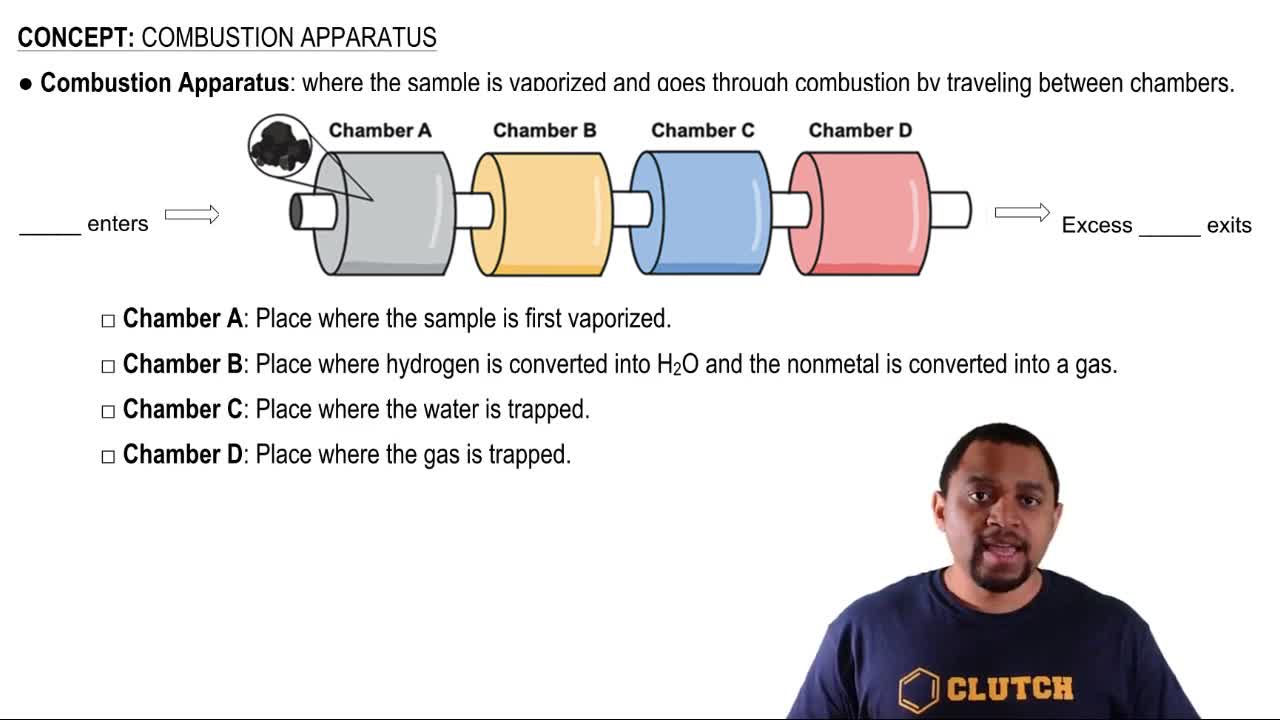
Combustion Apparatus

Stoichiometry

Stoichiometry is the quantitative relationship between the reactants and products in a chemical reaction. It allows us to determine how much of each substance is consumed or produced based on the balanced chemical equation. In this context, stoichiometry will help calculate the mass of CO2 produced per kJ of heat emitted by using the molar ratios from the combustion of methanol.
Video consigliato:
Percorso guidato
01:16
Stoichiometry Concept

Energy Release in Combustion

The energy released during combustion is typically measured in kilojoules (kJ) and is derived from the breaking and forming of chemical bonds. The heat of combustion for methanol can be found in thermodynamic tables, which provides the amount of energy released per mole of methanol burned. This value is crucial for determining the mass of CO2 produced per kJ of heat emitted, as it links the energy output to the amount of fuel consumed.
Video consigliato:
Percorso guidato
02:24
Combustion Apparatus