
Ch.5 - Thermochemistry
Brown - Chemistry: The Central Science 14th Edition
Brown14th EditionChemistry: The Central ScienceISBN: 9780134414232Non è quello che usi tu?Cambia libro di testo
Capitolo 5, Problema 119b

Suppose an Olympic diver who weighs 52.0 kg executes a straight dive from a 10-m platform. At the apex of the dive, the diver is 10.8 m above the surface of the water. (b) Assuming that all the potential energy of the diver is converted into kinetic energy at the surface of the water, at what speed, in m/s, will the diver enter the water?

Guida verificata passo dopo passo
1
Identify the initial potential energy (PE) of the diver at the apex of the dive using the formula: \( PE = mgh \), where \( m \) is mass, \( g \) is the acceleration due to gravity (9.8 m/s²), and \( h \) is the height (10.8 m).
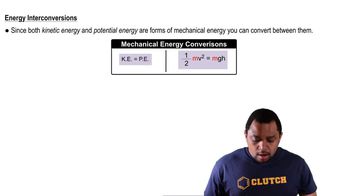
Assume that all the potential energy is converted into kinetic energy (KE) at the surface of the water. Therefore, set the potential energy equal to the kinetic energy: \( mgh = \frac{1}{2}mv^2 \).
Cancel the mass \( m \) from both sides of the equation since it appears in both terms.
Solve for the velocity \( v \) by rearranging the equation: \( v = \sqrt{2gh} \).
Substitute the known values for \( g \) and \( h \) into the equation to find the velocity \( v \).

Risposta video verificata per un problema simile:

Questa soluzione video è stata consigliata dai nostri tutor come utile per risolvere questo problema.
Durata del video:
3m

Concetti chiave

Ecco i concetti essenziali che devi comprendere per rispondere correttamente alla domanda.

Potential Energy

Potential energy (PE) is the energy stored in an object due to its position in a gravitational field. It is calculated using the formula PE = mgh, where m is mass, g is the acceleration due to gravity (approximately 9.81 m/s²), and h is the height above the reference point. In this scenario, the diver's potential energy at the apex of the dive is converted into kinetic energy as they fall.
Video consigliato:
Percorso guidato
00:34
Kinetic & Potential Energy

Kinetic Energy

Kinetic energy (KE) is the energy of an object in motion, defined by the equation KE = 0.5mv², where m is mass and v is velocity. As the diver descends, the potential energy is transformed into kinetic energy, which determines the speed of the diver just before entering the water. The conservation of energy principle states that the total energy remains constant, allowing us to equate the potential energy at the height to the kinetic energy at the water's surface.
Video consigliato:
Percorso guidato
00:34
Kinetic & Potential Energy

Conservation of Energy

The conservation of energy principle states that energy cannot be created or destroyed, only transformed from one form to another. In this context, the potential energy of the diver at the height of 10.8 m is converted entirely into kinetic energy as they fall. This principle allows us to calculate the diver's speed upon entering the water by setting the initial potential energy equal to the final kinetic energy.
Video consigliato:
Percorso guidato
01:48
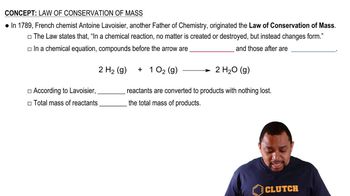
Law of Conservation of Mass