Ch.5 - Thermochemistry
Brown - Chemistry: The Central Science 14th Edition
Brown14th EditionChemistry: The Central ScienceISBN: 9780134414232Non è quello che usi tu?Cambia libro di testo
Capitolo 5, Problema 4a

The contents of the closed box in each of the following illustrations represent a system, and the arrows show the changes to the system during some process. The lengths of the arrows represent the relative magnitudes of q and w. (a) Which of these processes is endothermic?

Guida verificata passo dopo passo
1
Identify the terms: 'q' represents heat, and 'w' represents work. In thermodynamics, a process is endothermic if the system absorbs heat from the surroundings, meaning q is positive.
Examine the arrows: The length of the arrow labeled 'q' indicates the magnitude of heat transfer. A longer arrow pointing into the system suggests a larger amount of heat absorbed.
Compare the arrows: Look for the process where the arrow for 'q' is longer and points into the system, indicating a positive q value.
Consider the direction: Ensure that the arrow for 'q' is directed into the system, as this signifies an endothermic process.
Conclude: Identify the process with the characteristics of an endothermic reaction, where the system absorbs heat, indicated by a positive q value.

Risposta video verificata per un problema simile:

Questa soluzione video è stata consigliata dai nostri tutor come utile per risolvere questo problema.
Durata del video:
4m

Concetti chiave

Ecco i concetti essenziali che devi comprendere per rispondere correttamente alla domanda.

Endothermic Processes

An endothermic process is one that absorbs heat from its surroundings, resulting in a decrease in the temperature of the surroundings. In such processes, the system gains energy, typically in the form of heat (q > 0). Common examples include melting ice or evaporating water, where energy is required to break intermolecular bonds.
Video consigliato:
Percorso guidato
00:55
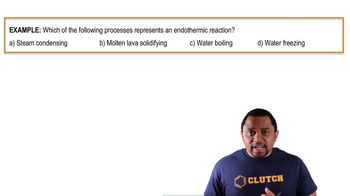
Endothermic & Exothermic Reactions Example 1

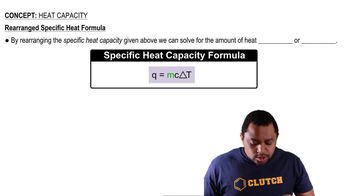
Heat (q) and Work (w)

In thermodynamics, heat (q) refers to the energy transferred due to temperature differences, while work (w) is the energy transferred when a force is applied over a distance. The signs of q and w indicate the direction of energy transfer: positive q means heat is absorbed by the system, and positive w means work is done on the system. Understanding these concepts is crucial for analyzing energy changes in a system.
Video consigliato:

Thermodynamic Diagrams

Thermodynamic diagrams visually represent changes in a system, often using arrows to indicate the direction and magnitude of heat and work. The length of the arrows correlates with the amount of energy transferred, helping to identify whether a process is endothermic or exothermic. Analyzing these diagrams allows for a clearer understanding of the energy dynamics involved in various processes.
Video consigliato:
Percorso guidato
01:18
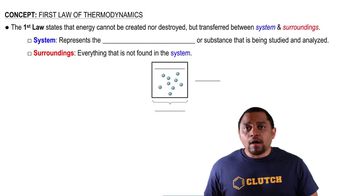
First Law of Thermodynamics