Ch.6 - Electronic Structure of Atoms
Brown - Chemistry: The Central Science 14th Edition
Brown14th EditionChemistry: The Central ScienceISBN: 9780134414232Non è quello che usi tu?Cambia libro di testo
Capitolo 6, Problema 49

Neutron diffraction is an important technique for determining the structures of molecules. Calculate the velocity of a neutron needed to achieve a wavelength of 125 pm. (Refer to the inside cover for the mass of the neutron.)

Guida verificata passo dopo passo
1
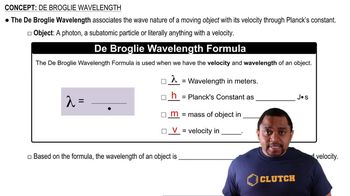
First, recall the de Broglie wavelength equation, which relates the wavelength (\( \lambda \)) of a particle to its momentum (\( p \)): \( \lambda = \frac{h}{p} \), where \( h \) is the Planck constant.
Next, express the momentum (\( p \)) in terms of mass (\( m \)) and velocity (\( v \)) of the neutron: \( p = m \cdot v \).
Substitute the expression for momentum into the de Broglie equation to relate wavelength, mass, and velocity: \( \lambda = \frac{h}{m \cdot v} \).
Rearrange the equation to solve for velocity (\( v \)): \( v = \frac{h}{m \cdot \lambda} \).
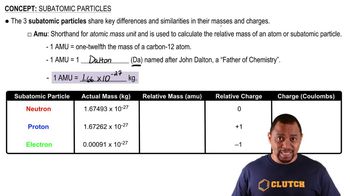
Finally, use the given wavelength (125 pm) and the mass of a neutron (refer to the inside cover of your textbook or a reliable source) to calculate the velocity.

Risposta video verificata per un problema simile:

Questa soluzione video è stata consigliata dai nostri tutor come utile per risolvere questo problema.
Durata del video:
1m

Concetti chiave

Ecco i concetti essenziali che devi comprendere per rispondere correttamente alla domanda.

De Broglie Wavelength

The De Broglie wavelength is a fundamental concept in quantum mechanics that relates the wavelength of a particle to its momentum. It is given by the formula λ = h/p, where λ is the wavelength, h is Planck's constant, and p is the momentum of the particle. For neutrons, this relationship is crucial for understanding how their wave-like properties can be utilized in diffraction experiments.
Video consigliato:
Percorso guidato
00:58
De Broglie Wavelength Formula

Momentum of a Particle

Momentum is a vector quantity defined as the product of an object's mass and its velocity (p = mv). In the context of neutron diffraction, the momentum of the neutron is essential for calculating its wavelength. Understanding how to manipulate this relationship allows for the determination of the velocity required to achieve a specific wavelength.
Video consigliato:
Percorso guidato
05:19
Subatomic Particles

Neutron Properties

Neutrons are subatomic particles found in the nucleus of an atom, possessing a mass approximately equal to that of a proton but no electric charge. Their unique properties, including their ability to penetrate materials without causing ionization, make them particularly useful in diffraction techniques for studying molecular structures. Knowing the mass of the neutron is vital for calculations involving its velocity and wavelength.
Video consigliato:
Percorso guidato
01:38
Neutron-to-Proton Plot
Pratica correlata
Domanda del libro di testo

Use the de Broglie relationship to determine the wavelengths of the following objects: (a) an 85-kg person skiing at 50 km/hr (b) a 10.0-g bullet fired at 250 m/s

695
views

Domanda del libro di testo

Using Heisenberg's uncertainty principle, calculate the uncertainty in the position of (b) a proton moving at a speed of 15.00 { 0.012 * 104 m/s. (The mass of a proton is given in the table of fundamental constants in the inside cover of the text.)

588
views
Domanda del libro di testo

Using Heisenberg's uncertainty principle, calculate the uncertainty in the position of (a) a 1.50-mg mosquito moving at a speed of 1.40 m/s if the speed is known to within {0.01 m/s;

1438
views
Domanda del libro di testo

Calculate the uncertainty in the position of (a) an electron moving at a speed of 13.00 ± 0.012 × 10⁵ m/s (b) a neutron moving at this same speed. (The masses of an electron and a neutron are given in the table of fundamental constants in the inside cover of the text.)

900
views
1
rank
Domanda del libro di testo

Among the elementary subatomic particles of physics is the muon, which decays within a few microseconds after formation. The muon has a rest mass 206.8 times that of an electron. Calculate the de Broglie wavelength associated with a muon traveling at 8.85 * 105 cm/s.

640
views
Domanda del libro di testo

Use the de Broglie relationship to determine the wavelengths of the following objects: (c) a lithium atom moving at 2.5 × 10⁵ m/s (d) an ozone (O3) molecule in the upper atmosphere moving at 550 m/s.

543
views