
If human height were quantized in 1-cm increments, what would happen to the height of a child as she grows up: (i) the child's height would never change, (ii) the child's height would continuously increase, (iii) the child's height would increase in jumps of 6 cm, or (iv) the child's height would increase in 'jumps' of 1 cm at a time?
Ch.6 - Electronic Structure of Atoms
Brown14th EditionChemistry: The Central ScienceISBN: 9780134414232Non è quello che usi tu?Cambia libro di testo
Capitolo 6, Problema 25a
(a) Calculate the energy of a photon of electromagnetic radiation whose frequency is 2.94 × 10¹⁴ s-1.
Guida verificata passo dopo passo1
Identify the given frequency of the electromagnetic radiation, which is \(2.94 \times 10^{14} \, \text{s}^{-1}\).
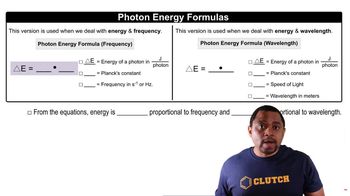
Recall the formula for the energy of a photon, which is given by Planck's equation: \(E = h \nu\), where \(E\) is the energy of the photon, \(h\) is Planck's constant (\(6.626 \times 10^{-34} \, \text{J} \cdot \text{s}\)), and \(\nu\) is the frequency of the radiation.
Substitute the given frequency and the value of Planck's constant into the equation.
Perform the multiplication to calculate the energy in joules (J).
Interpret the result, understanding that the energy calculated represents the energy carried by a single photon of the given electromagnetic radiation.

Risposta video verificata per un problema simile:
Questa soluzione video è stata consigliata dai nostri tutor come utile per risolvere questo problema.
Durata del video:
1mConcetti chiave
Ecco i concetti essenziali che devi comprendere per rispondere correttamente alla domanda.
Photon Energy
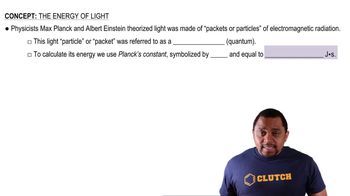
The energy of a photon is directly proportional to its frequency and can be calculated using the equation E = hν, where E is energy, h is Planck's constant (6.626 x 10^-34 J·s), and ν is the frequency in hertz. This relationship shows that higher frequency photons carry more energy.
Video consigliato:
Percorso guidato
Photon Energy Formulas
Planck's Constant
Planck's constant is a fundamental constant in quantum mechanics that relates the energy of a photon to its frequency. It is a key component in the equation E = hν, and its value is approximately 6.626 x 10^-34 J·s. Understanding this constant is essential for calculating photon energy.
Video consigliato:
Percorso guidato
Photons and Planck's Constant
Frequency of Electromagnetic Radiation
Frequency refers to the number of cycles of a wave that pass a point in one second, measured in hertz (Hz). In the context of electromagnetic radiation, frequency is inversely related to wavelength, and it plays a crucial role in determining the energy of the photon, as described by the equation E = hν.
Video consigliato:
Percorso guidato
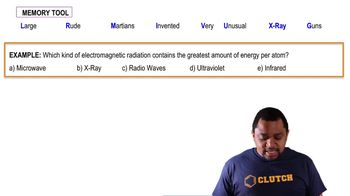
Electromagnetic Radiation Example
Pratica correlata
Domanda del libro di testo
463
views
Domanda del libro di testo
(b) Calculate the energy of a photon of radiation whose wavelength is 413 nm.
1040
views
Domanda del libro di testo
(c) What wavelength of radiation has photons of energy 6.06 × 10⁻¹⁹ J?
Domanda del libro di testo
It is possible to convert radiant energy into electrical energy using photovoltaic cells. Assuming equal efficiency of conversion, would infrared or ultraviolet radiation yield more electrical energy on a per-photon basis?
1683
views
Domanda del libro di testo
Einstein's 1905 paper on the photoelectric effect was the
first important application of Planck's quantum hypothesis.
Describe Planck's original hypothesis, and explain how
Einstein made use of it in his theory of the photoelectric
effect.
1140
views
Domanda del libro di testo
(a) A green laser pointer emits light with a wavelength of 532 nm. What is the frequency of this light?
1392
views
