
Ch.6 - Electronic Structure of Atoms
Brown - Chemistry: The Central Science 14th Edition
Brown14th EditionChemistry: The Central ScienceISBN: 9780134414232Non è quello che usi tu?Cambia libro di testo
Capitolo 6, Problema 31

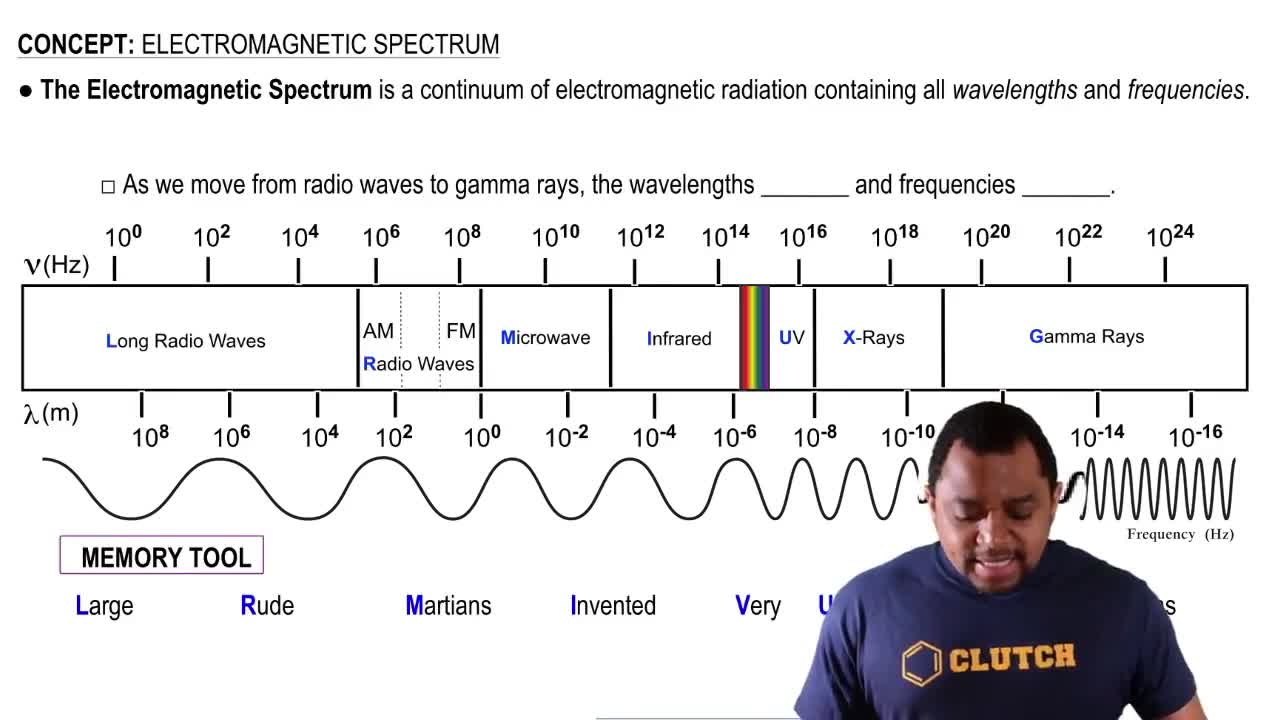
A diode laser emits at a wavelength of 987 nm. (a) In what portion of the electromagnetic spectrum is this radiation found? (b) All of its output energy is absorbed in a detector that measures a total energy of 0.52 J over a period of 32 s. How many photons per second are being emitted by the laser?

Guida verificata passo dopo passo
1
Step 1: Identify the portion of the electromagnetic spectrum where the radiation is found. The wavelength of the radiation is given as 987 nm. This falls within the near-infrared (NIR) region of the electromagnetic spectrum, which ranges from about 800 nm to 2500 nm.
Step 2: Calculate the energy of a single photon. Use the formula E = hc/λ, where h is Planck's constant (6.626 x 10^-34 J.s), c is the speed of light (3.00 x 10^8 m/s), and λ is the wavelength in meters. Remember to convert the wavelength from nm to m by multiplying by 10^-9.
Step 3: Calculate the total number of photons absorbed by the detector. Divide the total energy absorbed by the energy of a single photon. This will give you the total number of photons absorbed.
Step 4: Calculate the number of photons emitted per second. Divide the total number of photons absorbed by the total time in seconds. This will give you the number of photons emitted per second by the laser.

Risposta video verificata per un problema simile:

Questa soluzione video è stata consigliata dai nostri tutor come utile per risolvere questo problema.
Durata del video:
7m

Concetti chiave

Ecco i concetti essenziali che devi comprendere per rispondere correttamente alla domanda.

Electromagnetic Spectrum

The electromagnetic spectrum encompasses all types of electromagnetic radiation, arranged by wavelength or frequency. It includes gamma rays, X-rays, ultraviolet light, visible light, infrared radiation, microwaves, and radio waves. A wavelength of 987 nm falls within the infrared region, which is just beyond the visible spectrum, indicating that this radiation is not visible to the human eye but can be detected by specialized instruments.
Video consigliato:
Percorso guidato
02:53
Electromagnetic Spectrum

Photon Energy

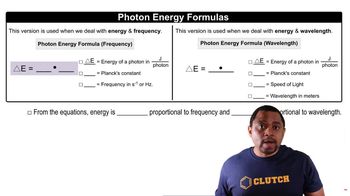
Photons are particles of light that carry energy, which can be calculated using the equation E = hc/λ, where E is energy, h is Planck's constant, c is the speed of light, and λ is the wavelength. For the diode laser emitting at 987 nm, this equation allows us to determine the energy of a single photon. Understanding photon energy is crucial for calculating the number of photons emitted based on the total energy detected.
Video consigliato:
Percorso guidato
01:40
Photon Energy Formulas

Photon Emission Rate

The photon emission rate refers to the number of photons emitted per unit time, typically expressed in photons per second. To find this rate, one can divide the total energy detected by the energy of a single photon and then divide by the time period over which the energy was measured. This concept is essential for quantifying the output of the laser in terms of its photon production, which is relevant in various applications, including telecommunications and medical devices.
Video consigliato:
Pratica correlata
Domanda del libro di testo

A stellar object is emitting radiation at 3.0 mm. (a) What type of electromagnetic spectrum is this radiation (b) If a detector is capturing 3.0 3 108 photons per second at this wavelength, what is the total energy of the photons detected in 1 day?

679
views
Domanda del libro di testo

One type of sunburn occurs on exposure to UV light of wavelength in the vicinity of 325 nm. (d) These UV photons can break chemical bonds in your skin to cause sunburn—a form of radiation damage. If the 325-nm radiation provides exactly the energy to break an average chemical bond in the skin, estimate the average energy of these bonds in kJ/mol.

1890
views
Domanda del libro di testo

Molybdenum metal must absorb radiation with an energy higher than 7.22 * 10-19 J ('energy threshold') before it can eject an electron from its surface via the photoelectric effect. (a) What is the frequency threshold for emission of electrons?

863
views
Domanda del libro di testo

One type of sunburn occurs on exposure to UV light of wavelength in the vicinity of 325 nm. (c) How many photons are in a 1.00 mJ burst of this radiation?

926
views
Domanda del libro di testo

Molybdenum metal must absorb radiation with an energy higher than 7.22 * 10-19 J ('energy threshold') before it can eject an electron from its surface via the photoelectric effect. (b) What wavelength of radiation will provide a photon of this energy?

656
views
1
comments
Domanda del libro di testo

The energy from radiation can be used to rupture chemical bonds. A minimum energy of 192 kJ/mol is required to break the bromine–bromine bond in Br2. What is the longest wavelength of radiation that possesses the necessary energy to break the bond? What type of electromagnetic radiation is this?

1758
views
2
rank