


Ch.6 - Electronic Structure of Atoms
Brown - Chemistry: The Central Science 14th Edition
Brown14th EditionChemistry: The Central ScienceISBN: 9780134414232Non è quello che usi tu?Cambia libro di testo
Capitolo 6, Problema 21b

A laser pointer used in a lecture hall emits light at 650 nm. Using Figure 6.4, predict the color associated with this wavelength.

Guida verificata passo dopo passo
1
Identify the given wavelength of the laser pointer, which is 650 nm.
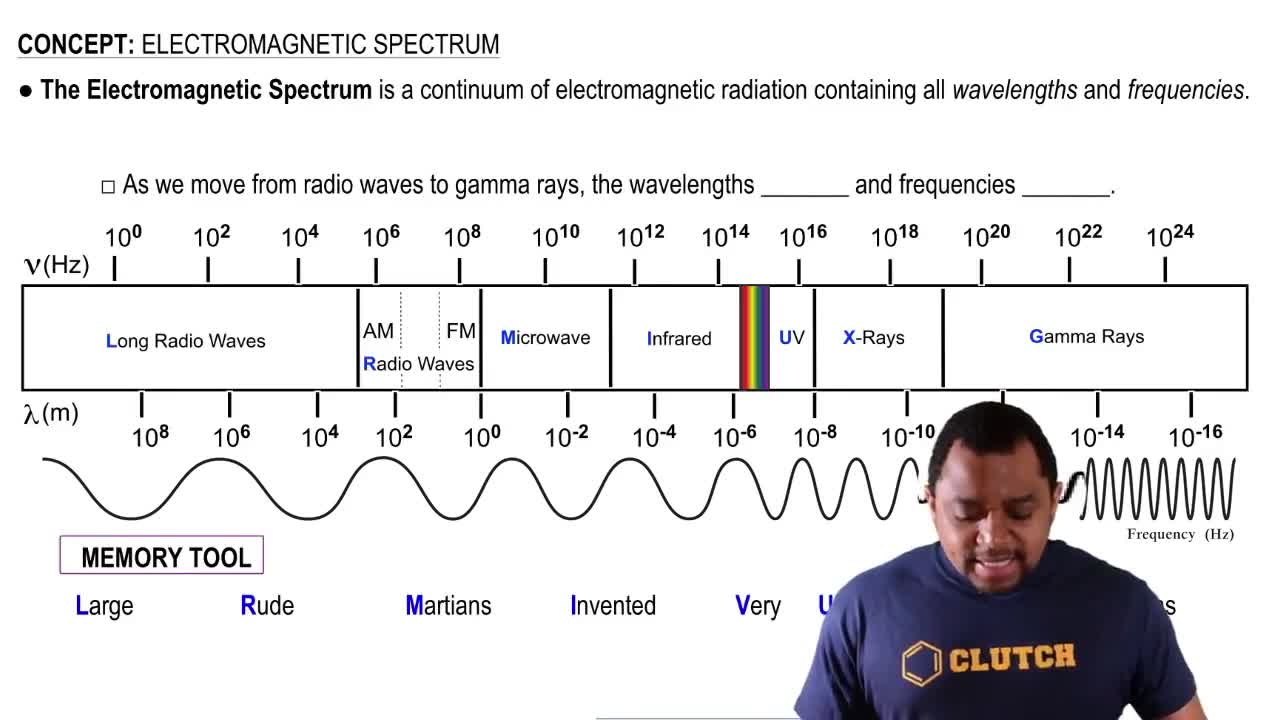
Understand that visible light is part of the electromagnetic spectrum, which ranges from approximately 400 nm to 700 nm.
Recall that different wavelengths within the visible spectrum correspond to different colors.
Consult Figure 6.4 or a similar reference that maps specific wavelength ranges to colors in the visible spectrum.
Determine the color associated with the 650 nm wavelength by locating it within the red region of the visible spectrum.

Risposta video verificata per un problema simile:

Questa soluzione video è stata consigliata dai nostri tutor come utile per risolvere questo problema.
Durata del video:
38s

Concetti chiave

Ecco i concetti essenziali che devi comprendere per rispondere correttamente alla domanda.

Electromagnetic Spectrum

The electromagnetic spectrum encompasses all types of electromagnetic radiation, including visible light, which ranges from approximately 400 nm (violet) to 700 nm (red). Each wavelength corresponds to a specific color perceived by the human eye. Understanding where 650 nm falls within this spectrum is essential for predicting the color emitted by the laser pointer.
Video consigliato:
Percorso guidato
02:53
Electromagnetic Spectrum

Wavelength and Color Perception

Wavelength is a key factor in determining the color of light. In the visible spectrum, shorter wavelengths correspond to colors like violet and blue, while longer wavelengths correspond to red. At 650 nm, the light emitted by the laser pointer is in the red region of the spectrum, which is crucial for accurately identifying the color associated with this wavelength.
Video consigliato:
Percorso guidato
00:31
Frequency-Wavelength Relationship

Color Mixing and Perception

Color perception is influenced by how different wavelengths of light mix and how they are interpreted by the human eye. The primary colors of light (red, green, and blue) combine in various ways to produce other colors. In the case of a laser pointer emitting light at 650 nm, the direct perception of red light is straightforward, as it does not involve mixing with other colors.
Video consigliato:
Percorso guidato
03:10
Scientific Notation Mixed Operations