Ch.6 - Electronic Structure of Atoms
Brown - Chemistry: The Central Science 14th Edition
Brown14th EditionChemistry: The Central ScienceISBN: 9780134414232Non è quello che usi tu?Cambia libro di testo
Capitolo 6, Problema 65

(b) In what sense does a 2p orbital have directional character? Compare the 'directional' characteristics of the px and dx² - y² orbitals. (That is, in what direction or region of space is the electron density concentrated?)

Guida verificata passo dopo passo
1
Understand the concept of atomic orbitals: Atomic orbitals are regions in space where there is a high probability of finding an electron. Each type of orbital (s, p, d, f) has a unique shape and orientation.
Describe the 2p orbital: The 2p orbitals are dumbbell-shaped and have directional character because they are oriented along the x, y, or z axes. This means that the electron density is concentrated along these axes, giving them a specific direction in space.
Explain the px orbital: The px orbital is one of the three 2p orbitals, and it is oriented along the x-axis. The electron density is concentrated in two lobes on either side of the nucleus along the x-axis, indicating its directional character.
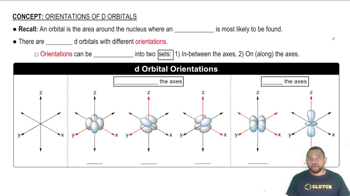
Describe the dx² - y² orbital: The dx² - y² orbital is one of the five d orbitals. It has a cloverleaf shape with lobes lying along the x and y axes. The electron density is concentrated in these lobes, making it directional, but in a different way compared to the p orbitals.
Compare the directional characteristics: While the px orbital has electron density concentrated along the x-axis, the dx² - y² orbital has electron density concentrated along both the x and y axes. This means the dx² - y² orbital has a more complex directional character, with electron density in regions between the axes as well.

Concetti chiave

Ecco i concetti essenziali che devi comprendere per rispondere correttamente alla domanda.

Orbital Shapes and Orientation

Orbitals are regions in an atom where there is a high probability of finding electrons. The 2p orbitals, which include px, py, and pz, have distinct shapes and orientations in three-dimensional space. The px orbital, for example, is oriented along the x-axis, while the py and pz orbitals are oriented along the y and z axes, respectively. This directional character influences how atoms interact and bond with one another.
Video consigliato:
Percorso guidato
02:06
d Orbital Orientations

Electron Density Distribution

Electron density refers to the probability of finding an electron in a particular region of space around the nucleus. In the case of the px orbital, the electron density is concentrated along the x-axis, while the dx² - y² orbital has a unique shape that focuses electron density along the x and y axes, forming lobes in the quadrants of the xy-plane. Understanding these distributions is crucial for predicting chemical bonding and molecular geometry.
Video consigliato:
Percorso guidato
02:47
Velocity Distributions

Comparison of Orbital Characteristics

When comparing the px and dx² - y² orbitals, it is important to note their different shapes and electron density distributions. The px orbital has a simple lobular shape along the x-axis, while the dx² - y² orbital has a more complex shape with four lobes oriented towards the corners of the xy-plane. This difference in orientation and shape affects how these orbitals overlap with others during chemical bonding, influencing molecular structure and reactivity.
Video consigliato:
Percorso guidato
03:06
Molecular Orbital Theory