

Ch.6 - Electronic Structure of Atoms
Brown - Chemistry: The Central Science 14th Edition
Brown14th EditionChemistry: The Central ScienceISBN: 9780134414232Non è quello che usi tu?Cambia libro di testo
Capitolo 6, Problema 89a

Consider a transition in which the electron of a hydrogen atom is excited from n = 1 to n = ∞. (a) What is the end result of this transition?

Guida verificata passo dopo passo
1
Identify the initial and final energy levels of the electron. In this case, the electron transitions from the initial level n = 1.
Recognize that the final energy level n is not specified in the problem. To proceed, you would need the correct final energy level.
Understand that the energy difference between these levels determines the energy of the photon involved in the transition. The energy can be calculated using the formula: \( E = E_f - E_i \), where \( E_i \) and \( E_f \) are the initial and final energy states of the electron.
Recall that the energy levels of a hydrogen atom are given by the formula: \( E_n = -\frac{13.6 \text{ eV}}{n^2} \), where n is the principal quantum number.
If the final energy level n were known, you could calculate the energy of the photon emitted or absorbed during this transition using the difference in energy levels formula and then determine whether the electron absorbs or emits a photon.

Risposta video verificata per un problema simile:

Questa soluzione video è stata consigliata dai nostri tutor come utile per risolvere questo problema.
Durata del video:
1m

Concetti chiave

Ecco i concetti essenziali che devi comprendere per rispondere correttamente alla domanda.

Quantum Energy Levels

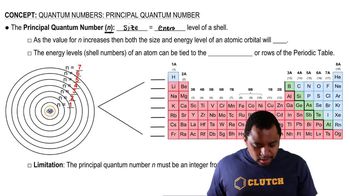
In quantum mechanics, electrons in an atom occupy discrete energy levels, denoted by quantum numbers (n). For hydrogen, these levels are quantized, meaning an electron can only exist in specific states. The transition from a lower energy level (n=1) to a higher one (n=2, for example) involves the absorption of energy, typically in the form of a photon.
Video consigliato:
Percorso guidato
02:55
Principal Quantum Number

Photon Absorption

When an electron transitions from a lower to a higher energy level, it absorbs a photon whose energy matches the difference between the two levels. The energy of the photon is given by the equation E = hf, where E is energy, h is Planck's constant, and f is the frequency of the photon. This process is fundamental in understanding how atoms interact with light.
Video consigliato:
Percorso guidato
00:41
Moles and Photon Energy

Excited State

An excited state refers to an electron configuration where an electron has absorbed energy and moved to a higher energy level than its ground state. In the case of hydrogen, when the electron transitions from n=1 to n=2, it is in an excited state. This state is typically unstable, and the electron will eventually return to the ground state, often releasing energy in the form of light.
Video consigliato:
Percorso guidato
03:25
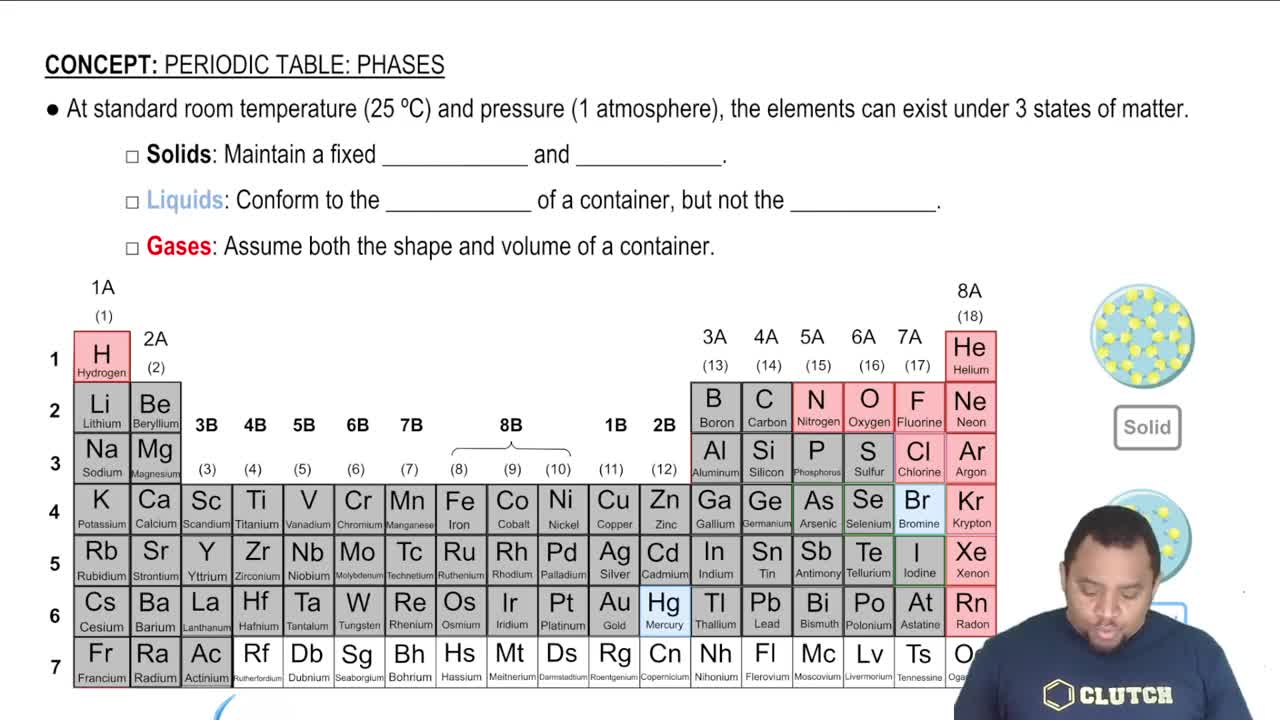
Element States of Matter