(d) For the hydrogen atom, list the following orbitals in order of increasing energy (that is, most stable ones first): 4f, 6s, 3d, 1s, 2p.
Ch.6 - Electronic Structure of Atoms
Brown14th EditionChemistry: The Central ScienceISBN: 9780134414232Non è quello che usi tu?Cambia libro di testo
Capitolo 6, Problema 66d
(d) For the hydrogen atom, list the following orbitals in order of increasing energy: 3s, 2s, 2p, 5s, 4d.
Guida verificata passo dopo passo1
Identify the principal quantum number (n) for each orbital, which indicates the energy level. For example, in the 3s orbital, n=3.
Recognize that for a hydrogen atom, the energy of an orbital primarily depends on the principal quantum number (n). Orbitals with a lower n value have lower energy.
Arrange the orbitals by their principal quantum number (n) in ascending order. If two orbitals have the same n value, they have the same energy in a hydrogen atom.
List the orbitals in order from the lowest n value to the highest n value. Since all orbitals with the same n value have the same energy in hydrogen, they can be listed in any order within the same n value.
Final order from lowest to highest energy for the hydrogen atom will be: 2s, 2p, 3s, 4d, 5s.

Risposta video verificata per un problema simile:
Questa soluzione video è stata consigliata dai nostri tutor come utile per risolvere questo problema.
Durata del video:
6mConcetti chiave
Ecco i concetti essenziali che devi comprendere per rispondere correttamente alla domanda.
Quantum Numbers
Quantum numbers describe the properties of atomic orbitals and the electrons in them. The principal quantum number (n) indicates the energy level, while the azimuthal quantum number (l) defines the shape of the orbital. For example, s orbitals have l=0, p orbitals have l=1, and d orbitals have l=2. Understanding these numbers is essential for determining the energy hierarchy of orbitals.
Video consigliato:
Percorso guidato
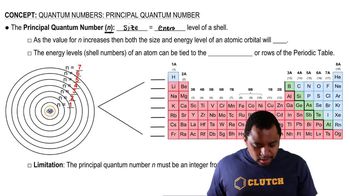
Principal Quantum Number
Aufbau Principle
The Aufbau principle states that electrons occupy the lowest energy orbitals first before filling higher energy levels. This principle guides the order in which orbitals are filled in an atom, which is crucial for determining the electron configuration. For hydrogen, the order of increasing energy for the given orbitals follows this principle, allowing us to rank them accurately.
Video consigliato:
Percorso guidato
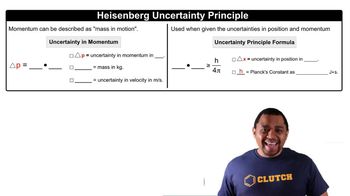
Uncertainty Principle Formula
Energy Levels and Sublevels
Energy levels in an atom are divided into sublevels (s, p, d, f) that have different energy states. The energy of these sublevels increases with the principal quantum number and the type of sublevel. For instance, within the same principal level, p orbitals are higher in energy than s orbitals, and d orbitals are higher than p orbitals. This hierarchy is essential for ordering the given orbitals by energy.
Video consigliato:
Percorso guidato
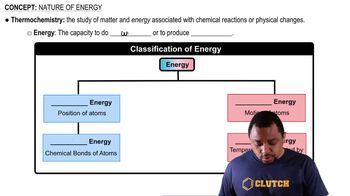
Nature of Energy
Pratica correlata
Domanda del libro di testo
859
views
Domanda del libro di testo
(a) For an He+ ion, do the 2s and 2p orbitals have the same energy? If not, which orbital has a lower energy?
862
views
Domanda del libro di testo
(b) If we add one electron to form the He atom, would your answer to part (a) change?
917
views
Domanda del libro di testo
(a) With reference to Figure 6.19, what is the relationship between the number of nodes in an s orbital and the value of the principal quantum number?
785
views
Domanda del libro di testo
(a) The average distance from the nucleus of a 3s electron in a chlorine atom is smaller than that for a 3p electron. In light of this fact, which orbital is higher in energy?
1123
views
Domanda del libro di testo
(b) Identify the number of nodes; that is, identify places where the electron density is zero, in the 2px orbital; in the 3s orbital.
748
views